Thursday, September 9, 2010
DID YOU KNOW?
. . . that the words "race car" spelled backward still spell "race car"?
. . . that "eat" is the only word that, if you take the 1st letter and move it to the last, it spells its past tense, "ate"?
And have you noticed that if you rearrange the letters in "illegal immigrants," and add just a few more letters, it spells:
"Go home you free-loading, benefit-grabbing, resource-sucking, baby-making, violent, non-English-speaking assholes and take those other hairy-faced, sandal-wearing, bomb-making, camel-riding, goat-loving, raggedy-ass bastards with you."
HOW WEIRD IS THAT?
.


FIRST BUTTS
Left to right - Princess Letizia of Spain , French first lady Carla Bruni and, yep, you guessed it . . . and, yep, you guessed it . . .


Wednesday, September 8, 2010
STILL A GUT WRENCHER
US Marines visit the ancient battle field, pay their respects on what is now sacred soil . . .

Mount Suribachi, overlooking Invasion Beach.
An interesting presentation (with Elvis' American Trilogy) -
IWO JIMA TODAY

(Sent in by Chas - the music didn't open on my computer - S.L.)

Mount Suribachi, overlooking Invasion Beach.
An interesting presentation (with Elvis' American Trilogy) -
IWO JIMA TODAY

(Sent in by Chas - the music didn't open on my computer - S.L.)
AERIAL ARCHEOLOGY IN BRITAIN
Hundreds of archaeological sites left buried for centuries were revealed this summer thanks to weeks of dry weather, which allowed experts to take aerial photos of 'cropmark sites'.
The marks are produced when crops growing over buried features develop at a different rate from those growing next to them.
A Roman camp near Bradford Abbas, Dorset, was revealed in June after three sides became visible in rain-parched fields of barley.
The lightly-built defensive enclosure would have provided basic protection for Roman soldiers while on maneuvers in the first century AD and is one of only four discovered in the south west of England.
 An aerial view of a Roman fort dating back 2,000 years was found in North Yorkshire, above. 'Cropmark sites' occur when when crops growing over buried features develop at a different rate from those growing next to them
Dry conditions allowed sites to be photographed in greater detail. Newton Kyme in North Yorkshire, was shown to not only be home to a Roman fort dating back 2,000 years but also a larger, stronger defense built in 290AD; stone walls up to three meters thick and a ditch 15 meters wide were revealed.
Dave MacLeod, an English Heritage senior investigator based in York, said: "It's hard to remember a better year."
 The stone walls of a Roman fort dating back 2,000 years can clearly be seen through crops in Newton Kyme in North Yorkshire. The images were taken by English Heritage from a Cessna light aircraft
Cropmarks are always at their best in dry weather. "This year we have taken full advantage of the conditions. We try to concentrate on areas that in an average year don't produce much archaeology.
"Sorties to the West Midlands and Cumbria, together with more local areas such as the Yorkshire Wolds and Vale of York, have all been very rewarding."
Flights over the Holderness area of the East Riding proved particularly productive with around 60 new sites, mainly prehistoric, found in just one day including livestock and settlement enclosures.
 Researchers hope to discover new sites after examining the photographs taken this summer. This image shows a 'lost' beach where the Romans landed 2,000 years ago to begin their invasion of Britain. Found two years ago, the remains of the shingle harbor were buried beneath 6ft of soil nearly two miles inland from the modern Kent coast.
Some sites which have not been visible since the drought of 1976 reappeared this summer.
Damian Grady, a Swindon-based English Heritage senior investigator, said: "Promising signs started to emerge in late May when the dry conditions had started to reveal cropmarks on well drained soils, especially river gravels and chalk in the east and south east of England.
"By June it became clear that the continuing dry conditions would produce good results across most of the country.
"We then targeted areas that do not always produce cropmarks, such as clay soils, or have seen little reconnaissance in recent years due to recent wet summers or busy airspace.
"Unfortunately July saw deterioration in the weather which reduced the amount of flying we could do and the cropmarks started to disappear just before the harvest got under way."
Mr Grady added: "It will take some time to take stock of all the sites we have photographed, but we expect to discover several hundred new sites across England."
The ash cloud grounded all planes except the Cessna
Damian Grady, English Heritage Senior Investigator based in Swindon, said: “This year’s summer got off to an unusual start when the Icelandic ash cloud closed down a lot of airspace to jet aircraft. Fortunately the piston-powered Cessnas used by aerial archaeologists were not affected by the ash, so it was easier to undertake planned flights inside airspace around Gatwick, Stansted, Luton and Bristol airports."
Source: English Heritage

.
The marks are produced when crops growing over buried features develop at a different rate from those growing next to them.
A Roman camp near Bradford Abbas, Dorset, was revealed in June after three sides became visible in rain-parched fields of barley.
The lightly-built defensive enclosure would have provided basic protection for Roman soldiers while on maneuvers in the first century AD and is one of only four discovered in the south west of England.
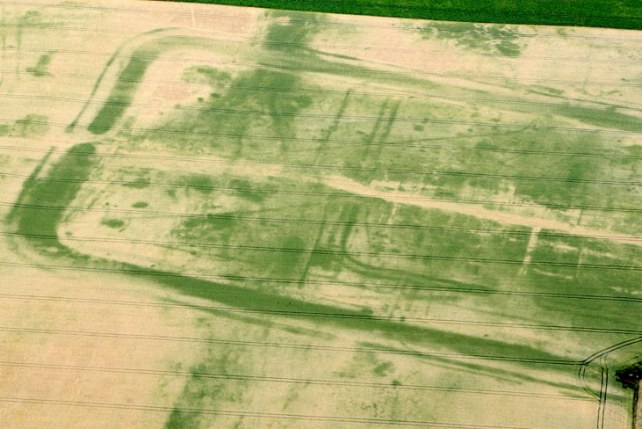 An aerial view of a Roman fort dating back 2,000 years was found in North Yorkshire, above. 'Cropmark sites' occur when when crops growing over buried features develop at a different rate from those growing next to them
Dry conditions allowed sites to be photographed in greater detail. Newton Kyme in North Yorkshire, was shown to not only be home to a Roman fort dating back 2,000 years but also a larger, stronger defense built in 290AD; stone walls up to three meters thick and a ditch 15 meters wide were revealed.
Dave MacLeod, an English Heritage senior investigator based in York, said: "It's hard to remember a better year."
 The stone walls of a Roman fort dating back 2,000 years can clearly be seen through crops in Newton Kyme in North Yorkshire. The images were taken by English Heritage from a Cessna light aircraft
Cropmarks are always at their best in dry weather. "This year we have taken full advantage of the conditions. We try to concentrate on areas that in an average year don't produce much archaeology.
"Sorties to the West Midlands and Cumbria, together with more local areas such as the Yorkshire Wolds and Vale of York, have all been very rewarding."
Flights over the Holderness area of the East Riding proved particularly productive with around 60 new sites, mainly prehistoric, found in just one day including livestock and settlement enclosures.
 Researchers hope to discover new sites after examining the photographs taken this summer. This image shows a 'lost' beach where the Romans landed 2,000 years ago to begin their invasion of Britain. Found two years ago, the remains of the shingle harbor were buried beneath 6ft of soil nearly two miles inland from the modern Kent coast.
Some sites which have not been visible since the drought of 1976 reappeared this summer.
Damian Grady, a Swindon-based English Heritage senior investigator, said: "Promising signs started to emerge in late May when the dry conditions had started to reveal cropmarks on well drained soils, especially river gravels and chalk in the east and south east of England.
"By June it became clear that the continuing dry conditions would produce good results across most of the country.
"We then targeted areas that do not always produce cropmarks, such as clay soils, or have seen little reconnaissance in recent years due to recent wet summers or busy airspace.
"Unfortunately July saw deterioration in the weather which reduced the amount of flying we could do and the cropmarks started to disappear just before the harvest got under way."
Mr Grady added: "It will take some time to take stock of all the sites we have photographed, but we expect to discover several hundred new sites across England."
The ash cloud grounded all planes except the Cessna
Damian Grady, English Heritage Senior Investigator based in Swindon, said: “This year’s summer got off to an unusual start when the Icelandic ash cloud closed down a lot of airspace to jet aircraft. Fortunately the piston-powered Cessnas used by aerial archaeologists were not affected by the ash, so it was easier to undertake planned flights inside airspace around Gatwick, Stansted, Luton and Bristol airports."
Source: English Heritage

.
Tuesday, September 7, 2010
CANADIAN 'DIRTY-BOMB' TERROR PLOT UNCOVERED
This is kind of dated but hey, this isn't a news service it's a blog, a large part of which is dedicated to national security . . . read down to the bottom part WHO ARE THE SUSPECTS? - kind of puts a kink in my theme about the "moderate" Muslims . . . interested in hearing your thoughts - S.L.
TERRORIST SUSPECT WAS EMPLOYED AT ISOTOPE-STOCKED HOSPITAL
Friday, Aug. 27, 2010 - Agence France-Presse
One of several Canadian men suspected of plotting a terrorist bombing campaign worked at a hospital that houses medical isotopes that could be used in a radiological ‘dirty bomb.’
Misbahuddin Ahmed's work as an X-ray technician would not have brought him into contact with radioactive material used at the Ottawa Hospital's radiology center, hospital administrators said.
Ahmed, 26, was arrested with Hiva Alizadeh, 30, also of Ottawa, and Khuram Sher, 28, of London, Ontario.
"Investigators have grounds to believe that Alizadeh, Ahmed and Sher are part of a domestic terrorist group operating in Canada," Royal Canadian Mounted Police Superintendent Serge Therriault told reporters.
"We also believe that Alizadeh is a member of, and remains in contact with, a terrorist group with links to the conflict in Afghanistan," he said.
Authorities searched the three men's homes, confiscating what they said were dozens of electronic circuit boards that could be used to detonate a bomb from a distance, along with books, drawings and other items that could help in preparing explosives. One of the suspects was believed to have undergone explosives training in another nation.
The "large amount of terrorist documentation and manuals" indicates the men "intended to construct an explosive device or explosive devices for terrorist purposes," Therriault said.
WHO ARE THE SUSPECTS?
 Misbahuddin Ahmed: X-ray technician was ‘reliable,’ his boss says. By most accounts, Misbahuddin Ahmed lived a traditional Muslim life. His colleagues at the Civic campus of the Ottawa Hospital praised his work ethic and his demeanour — by all accounts, an all-around good guy.

Dr. Khurram Syed Sher, 28, once auditioned for Canadian Idol; he's a father of three, a doctor, and recently moved to London, Ontario to work as a pathologist at the St. Thomas Elgin General Hospital.

Hiva Mohammad Alizadeh, 30, faces the most serious charges. Hiva is a Sunni Muslim whose parents live in Iran, a former employer says. He lived in Manitoba for years and once attended college to study English and electrical engineering.
“It’s not good news. I’m really sad because as far as I know of Hiva, he was a good guy, he was very good,” Yusuf Abdulrehman told the CBC. Mr. Abdulrehman said Mr. Alizadeh worked at his store, Halal Meats Centre in Winnipeg, for several years.
.
Monday, September 6, 2010
MERCENARIES . . .

CENTRAL AFRICAN REPUBLIC ARRESTS SLOVAKS ON COUP PLOT
BANGUI - Agence France - Security forces in the Central African Republic arrested a group of Slovakian nationals last week for involvement in an alleged coup plot, a government spokesman told AFP Monday.
or . . . ? ? ?
SLOVAK TOURISTS MISTAKEN FOR COUP PLOTTERS
A group of Slovak citizens who were seized by the army in the Central African Republic (CAR) last week have been released, the authorities in Bratislava said Monday. The armed safari hunters had apparently been mistaken for coup plotters.
Read more HERE
.
YOM KIPPUR WAR


The Yom Kippur War was fought from October 6 to 26, 1973, between Israel and a massive coalition of Arab states backing Egypt and Syria. The war began with a joint surprise attack on Yom Kippur, the holiest day in Judaism . . .
A great set of photos and maps . . . from DoubleTapper . . . via Theo Spark's Last of the Few . . .
. . . Israel initially fell back all the way across the Sinai, then in massive counter-attack operations regained lost terrain in the Sinai. In an audacious move, Israeli tanks crossed the Suez Canal and wrought havoc on Egyptian towns and cities, while up north IDF forces wrested the Golan Heights back from Syria.


There are many anecdotes about the Yom Kippur War. As the war raged, American war stocks were shipped from depots in Germany to Israel, along with advisors and logistical personnel. According to some sources, Israeli forces were advancing so swiftly that in the end, US troops were pulling the lanyards on the artillery pieces.
According to modern myth, the Yom Kippur war reportedly eventually ended when Soviet Premier Breshnev picked up the Kremlin / Whitehouse hotline and said to Nixon, "This has gone far enough; you can call off your boys now."
I had a schoolmate who participated in this war; Meier G__ graduated high school, went home to Israel, then showed up a year later (I was still in school) explaining how he had entered the IDF to do his mandatory military service, and then . . . the war broke out! My friend Meier rode an M-113 APC (Armored Personnel Carrier) across the Sinai. The way he told it, the Egyptians were throwing down their weapons and equipment and running for their lives. He explained that the Israelis would then stop and pick everything up; while he was saying - "Over there! We have to go over there! They're getting away!"
Meier's sister taught me to read a little Hebrew. They were good people; the beginning of my long association with the State of Israel. - S.L.
.
Subscribe to:
Posts (Atom)