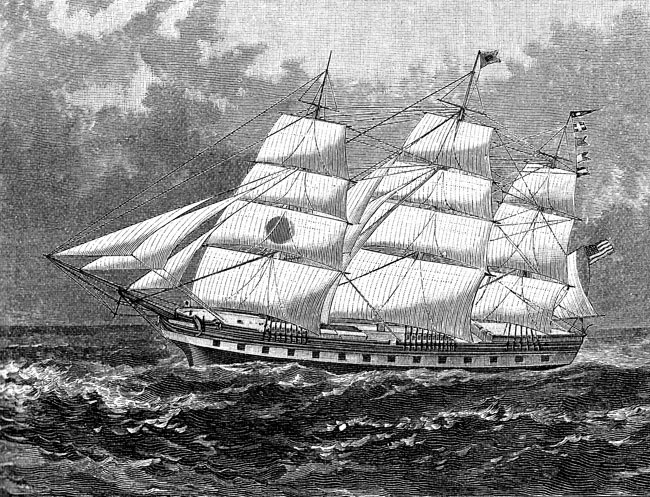
This is a story from the old sailing ship days.
In the old days, if a ship sailed across the ocean and made it back with a hull full of spices and other cargo, the profit earned was ten times the price of the ship itself. It was a very lucrative trade.
But sailing wooden ships across the ocean was very hazardous, and of all the ships that set sail, only about half of them made it back.

Therefore, what they would do was this: in the taverns down by the docks, ship owners would write the names of their ships on a big chalkboard, and people would place bets on which ships they thought would make it back.

The ship owners would take these bets until the cost of the ship was reached -
betting against themselves; these bets would be written beneath the name of each ship on the big board.
That way, if a ship didn't make it back, the replacement cost of the ship was covered. If the ship made it back, the owner would pay out the equivalent of ten percent of his profits, and he'd still have nine times the cost of his initial investment.
Because of the way they kept track of these bets on the boards, they called this system
UNDERWRITING.*************************************************************Benjamin Franklin was a very resourceful and energetic guy. Amongst his many activities, which included printing, writing philosophy, kite flying and electricity - he was a very active member of his community.

Amongst Franklin's civic contributions in his adopted city of Philadelphia, he helped launch projects to pave, clean and light the city streets. One of the chief accomplishments of Franklin in this era was helping to launch the Library Company in 1731. During this time books were scarce and expensive. Franklin recognized that by pooling together resources, members could afford to buy books from England. Thus was born the nation's first subscription library. In 1743, he helped to launch the American Philosophical Society, the first learned society in America. Recognizing that the city needed better help in treating the sick, Franklin brought together a group who formed the Pennsylvania Hospital in 1751. The Library Company, Philosophical Society, and Pennsylvania Hospital are all in existence today.
Fires were very dangerous threat to Philadelphians, so Franklin in 1736, he organized Philadelphia's Union Fire Company, the first in the city. His famous saying, "An ounce of prevention is worth a pound of cure," was actually fire-fighting advice.
Those who suffered fire damage to their homes often suffered irreversible economic loss. Benjamin Franklin recognized that if many home owners banded together and each contributed a small amount of money, then the small percentage of home owners whose houses burned down would be covered for their financial loss.

So, in 1752, Franklin helped to found the Philadelphia Contribution for Insurance Against Loss by Fire. Those with insurance policies were not wiped out financially.
Benjamin Franklin had inadvertently discovered the primary principle of insurance -
"INSURANCE ONLY WORKS WHEN IT COVERS THAT WHICH IS RANDOM, UNPREDICTABLE, AND CATASTROPHIC IN NATURE" - and his Contributionship is still in business today.

*************************************************************Now think about your car insurance. What is it for? What do you expect for it to cover?


It's for the unexpected, right? To pay for replacing your wheels after The Big Crunch:

Nowadays even a minor fender bender can end up costing thousands of dollars. We don't plan it happening, and only a small percentage of drivers will have an accident. But we are willing to pay a little bit of money now, against the possibility that when and if such expensive repairs - or even replacement - become necessary, we will be covered.
Remember Franklin's primary principle of insurance - it works if it covers that which is random, unpredictable, and catastrophic in nature.
Now think about your auto insurance policy again. Do you expect it to cover oil changes, wiper blades and a new set of tires every couple of years?

No, of course not. What would happen to the price of your premium if it DID cover these expenses? It would go up, right? WAY UP. Why?
That's right
- because it is no longer insurance - it is now a maintenance plan.
Does it make sense to give your money to somebody else to hold, handle, manage, and pay out when you need these predictable expenses? Or is it better to hang on to your money and invest it, then when you need some cash for tires, you've got it?
INSURANCE ONLY WORKS WHEN IT COVERS THAT WHICH IS RANDOM, UNPREDICTABLE, AND CATASTROPHIC IN NATURE.
*************************************************************You knew where I was going with all this, didn't you? Now Obama is forcing health insurance companies to accept people with pre-existing conditions.

What will happen to the price of health insurance over the next two years?
That's right: premiums will rise. They have to, because now they have to cover people who are already sick. This is not insurance; this is a maintenance plan.
Insurance companies will increase the price of premiums up to 200% and more.
Under Obamacare, new health insurance exchanges will be created, to serve the millions of new customers now eligible under the new law.
But when the insurance companies inevitably raise their rates on health coverage, Nancy Pelosi has already said that they will not be “automatically included” in the new health exchanges the bill creates.

“Unless they do the right thing, they’re not going in,” she said. “They will be relinquishing the possibility of having taxpayer-subsidized consumers in the exchange,” she said.
Health Insurance, as we now know it, will become unaffordable. Inevitably, the Government will have to step in to fully absorb healthcare costs. When they do so, they will have achieved a long sought-after goal of the American Left: Single-Payer Public Option, i.e.
SOCIALISM.This was Monday on WJR radio Detroit; John Dingell, the senior Democrat in the House of Representatives:
Did you catch that? "TO CONTROL THE PEOPLE."
". . . we're not ready to be doing it, but let me remind you, this has been going on for years. We are bringing it to a halt. The harsh fact of the matter is when you're going to pass legislation that will cover 300 American people in different ways it takes a long time to do the necessary administrative steps that have to be taken to put the legislation together to control the people."It's not about Healthcare at all. It's certainly not about insurance. It's about government control of the most precious commodity you own:
YOUR LIFE.". . . it takes a long time to do the necessary administrative steps that have to be taken to put the legislation together
TO CONTROL THE PEOPLE."You just heard it coming from the mouth of U.S. Congressman John Dingell, the senior Democrat in the House of Representatives.
STORMBRINGER SENDS
.

 A Chinese student, Wang Jianwei, above, and his professor, wrote an academic paper on the vulnerability of the American power grid to a computer attack. Scientists said the paper was merely a technical exercise.
 Larry M. Wortzel, a military strategist, recently drew attention to the paper.