Thursday, April 21, 2011
SHANKAPOTOMUS
I can't believe what I'm seeing - somebody who sucks at golf ten times worse than I do!
What I say is, he has no "follow-through". I ain't a good golfer but I'm a damn good pistolero, and the principle is the same: most important thing - in golf as in combat pistol marksmanship - is follow-through.
Want to see a real swing? At the end of this analysis:
Now that's how a real man hits a golf ball.
Today's Bird HERE
.


THE EPITOME OF HONOR
A Marine Force Recon buddy sent this to me today; this is what the American warrior class does for it's own - we always bring them back. It might take fifty, or a hundred and fifty years, but in the end . . . we always bring them back.
This is Honor.
The Marine Raiders of World War II were the forerunners of Force Reconnaissance.

Also today, we honor Tim Hetherington, British war correspondent and photographer - killed in action, 20 April 2011 in the besieged Libyan city of Misurata.
Journalists go forward to the battle fronts as absolute volunteers - there is no requirement they go. This is guts, and they serve an important role as scribes of history. But in the end, theys rolls the dices and theys takes theys chances. Hetherington was worthy, however - he was director and producer of the film “Restrepo”

I saw that documentary; it was so real for me, it sent shivers up my spine.

.
This is Honor.
The Marine Raiders of World War II were the forerunners of Force Reconnaissance.

Also today, we honor Tim Hetherington, British war correspondent and photographer - killed in action, 20 April 2011 in the besieged Libyan city of Misurata.
Journalists go forward to the battle fronts as absolute volunteers - there is no requirement they go. This is guts, and they serve an important role as scribes of history. But in the end, theys rolls the dices and theys takes theys chances. Hetherington was worthy, however - he was director and producer of the film “Restrepo”

In 2007 and 2008, Hetherington spent 14 months with a platoon of
paratroopers from the famed 173d Airborne Brigade in the Korangal Valley, Afghanistan.
paratroopers from the famed 173d Airborne Brigade in the Korangal Valley, Afghanistan.
I saw that documentary; it was so real for me, it sent shivers up my spine.

Timothy (Tim) Hetherington, 1970 – April 20, 2011
.
Wednesday, April 20, 2011
U.S. & INDIAN ARMY SPECIAL FORCES
This is my old outfit -

1st Battalion, 1st Special Forces Group, out of Okinawa.
Never in a million years could I imagine "First of the First" up there in the snow in Alaska - we were tropical lightning, "Unleashed in the East" . . .
Thanks to THEO for bringing this gloriousness to my attention . . . S.L.
In honor of my old outfit and Indian Special Forces, here is some Southwest Asian Hotness wearing North American tribal colors.
.

1st Battalion, 1st Special Forces Group, out of Okinawa.
Never in a million years could I imagine "First of the First" up there in the snow in Alaska - we were tropical lightning, "Unleashed in the East" . . .
Thanks to THEO for bringing this gloriousness to my attention . . . S.L.
In honor of my old outfit and Indian Special Forces, here is some Southwest Asian Hotness wearing North American tribal colors.
.
RELIGION OF THE INDIG'

A reader writes:
I am not nor have I ever been in the forces, I have worked with a lot of working/serving personnel and one thing I do not understand is why when they are up against Muslims they do not use there primitive religion against them such as telling them that all our ammo is coated in pigs blood and that when we bury one of there dead we inter a dead Pigs body with it the sort of things that you had in the article on Black Jack Pershing they want to live by 13th century beliefs so use it against them you don't have to actually do all these things just start rumors and let them do the work like telling them that when you pick up the pieces of suicide bomber you bury them with bits of pig so they can not get into Paradise and that when they get caught they will get tied up using pig skin leather all little thing I know but for Religious nuts it will mean something and maybe discourage some.
- Z
Good question, Z-Man. Here's the short answer:
There's a little something out there called the Law of Land Warfare that will get you sent to Leavenworth for pulling stunts like this. Anyway at the U.S. Army JFK Special Warfare Center they taught us NEVER to mess with their religion - there is no way to control how a thing like that can boomerang right back at you in the wrong way direction. Believe it or not most of the Muslims are on our side and we want to keep it that way. Can you imagine if we infuriated ALL of them to the point where they ALL want to strap on bombs?

Better the sane Muslims see what decent, tolerant people we are. The current state of affairs cannot prevail; there is too much angst, hatred, ignorance and confusion out there. This is against the natural way of things. History shows us time and again that a set of circumstances may seemingly lead to a certain direction, but we humans are totally UN-predictable and that which is accepted as status quo can and will be upturned in the most unexpected and unorthodox manner.
Consider: in 1988 the Soviet Union was still going strong, people were still being hauled off to the Gulag, nuclear-tipped intercontinental ballistic missiles were pointed right at the heartland of America. Common knowledge had it that the Cold War was going to last FOREVER. But in 1989 a bunch of German nature-worshipers went out for a little Communist Bloc version of Woodstock and the next thing you know the punk rockers were KNOCKING DOWN THE FREAKING BERLIN WALL WITH SLEDGEHAMMERS ! ! !

So now we have this situation with the Muslims, and the only logic one can make of it is that it's unsustainable . . . eventually something has got to give . . . carried out to it's logical conclusion it makes the Cold War look like a Sunday School picnic . . . it's simply unsustainable. But what if something unexpected - totally unexpected - yet totally within the capacity of the human condition - HAPPENS?

What if, for example, one day all the good Muslims suddenly became Christians?
That would be a game-changer to say the least, and it's certainly within the realm of possibility.
For what it's worth, I owe my life to a Muslim, but that does not cloud my thinking; there are no rose-colored glasses. I am a soldier, first and foremost. Barring a miracle of Biblical proportions, it may very well be that in the end my brothers and I must be prepared to slay them in their thousands and their tens of thousands, until the blood runs knee-deep in the streets. Knee-deep, to the horses knees.
STORMBRINGER SENDS
Today's Bird HERE
.
Tuesday, April 19, 2011
THEY CAUGHT 'EM
FLASHBACK:
03/15 Palestinian Authority blames Fogel Family Killings on Thai Migrant Worker.

FASTFORWARD:
04/17 Killers of Fogel Family Caught:
 Hakim Maazan Niad Awad and Amjad Mahmud Fauzi Awad snuck into the Fogel home, saw children sleeping in their beds and stabbed them to death; the suspects are affiliated with the Popular Front for the Liberation of Palestine.
Who are the terrorists to murdered the Fogel family?
From the Jerusalem Post
Two Palestinian youths from the village of Awarta were arrested in recent days for the brutal slaying of five members of the Fogel family in their Itamar home last month, the IDF and Shin Bet said on Sunday following the lifting of a media ban on the investigation.
The suspects have been named as Hakim Maazan Niad Awad, an 18-year-old high school student, and Amjad Mahmud Fauzi Awad, 19, both from the West Bank village of Awarta, located 2 kilometers south of the settlement of Itamar.
The suspects have confessed to the stabbings and re-enacted the murders, security forces said on Sunday. According to Army Radio, they did not express remorse for their crimes.
There is a special place in Hell for pieces of manure like this pair - S.L.
Both men are affiliated with the Popular Front for the Liberation of Palestine (PLFP) terror group and received significant assistance from family members and friends after the attack, security forces added.
Transportation Minister Yisrael Katz on Sunday expressed his condolences once again to the Fogel family after the announcement of the arrests.
Katz told Army Radio, "To those Palestinians who said 'it can't be one of us' - well, it turned out to be one of you."
Read the rest of it HERE at the Jerusalem Post
.
03/15 Palestinian Authority blames Fogel Family Killings on Thai Migrant Worker.

FASTFORWARD:
04/17 Killers of Fogel Family Caught:

Who are the terrorists to murdered the Fogel family?
From the Jerusalem Post
Two Palestinian youths from the village of Awarta were arrested in recent days for the brutal slaying of five members of the Fogel family in their Itamar home last month, the IDF and Shin Bet said on Sunday following the lifting of a media ban on the investigation.
The suspects have been named as Hakim Maazan Niad Awad, an 18-year-old high school student, and Amjad Mahmud Fauzi Awad, 19, both from the West Bank village of Awarta, located 2 kilometers south of the settlement of Itamar.
The suspects have confessed to the stabbings and re-enacted the murders, security forces said on Sunday. According to Army Radio, they did not express remorse for their crimes.
There is a special place in Hell for pieces of manure like this pair - S.L.
Both men are affiliated with the Popular Front for the Liberation of Palestine (PLFP) terror group and received significant assistance from family members and friends after the attack, security forces added.
Transportation Minister Yisrael Katz on Sunday expressed his condolences once again to the Fogel family after the announcement of the arrests.
Katz told Army Radio, "To those Palestinians who said 'it can't be one of us' - well, it turned out to be one of you."
Read the rest of it HERE at the Jerusalem Post
.
ANOTHER ONE - DIFFERENT THIS TIME
Another phony caught out in a lie . . . what’s unusual is this time it’s a woman:
TOWN DUPED BY HER STORY OF SERVICE
 She said she was hurt in Afghanistan; but she wasn't even in the military. Photo: Cass Lake Times
MARK BRUNSWICK , Star Tribune - April 17, 2011
The town of Cass Lake embraced Elizabeth McKenzie last month when she arrived at the high school in her Army uniform for a welcome home ceremony.
Though she isn't a tribal member, the Leech Lake Band of Ojibwe Honor Guard gave her a blanket and an eagle feather to honor her as a woman warrior for her service in Afghanistan. There was a tribal drum ceremony and a reception line. Accepting the town's gratitude, McKenzie talked about the close calls she'd had and a war injury that brought her home. She led the march in the high school gym, carrying the American flag, and the local newspaper documented the hero's return.
But none of it was true. The 20-year-old McKenzie was never injured in combat, had never been to Afghanistan, never been deployed anywhere. In fact, she's never been in the military.
Now the 2009 grad of Cass Lake High School has been cited for impersonating an officer, which in Minnesota includes the military. And the people of Cass Lake are trying to recover from feeling duped by their own good intentions.
More HERE
Forget about this skank, check out today's Bird HERE
.
TOWN DUPED BY HER STORY OF SERVICE

MARK BRUNSWICK , Star Tribune - April 17, 2011
The town of Cass Lake embraced Elizabeth McKenzie last month when she arrived at the high school in her Army uniform for a welcome home ceremony.
Though she isn't a tribal member, the Leech Lake Band of Ojibwe Honor Guard gave her a blanket and an eagle feather to honor her as a woman warrior for her service in Afghanistan. There was a tribal drum ceremony and a reception line. Accepting the town's gratitude, McKenzie talked about the close calls she'd had and a war injury that brought her home. She led the march in the high school gym, carrying the American flag, and the local newspaper documented the hero's return.
But none of it was true. The 20-year-old McKenzie was never injured in combat, had never been to Afghanistan, never been deployed anywhere. In fact, she's never been in the military.
Now the 2009 grad of Cass Lake High School has been cited for impersonating an officer, which in Minnesota includes the military. And the people of Cass Lake are trying to recover from feeling duped by their own good intentions.
More HERE
Forget about this skank, check out today's Bird HERE
.
Monday, April 18, 2011
WAR IN THE LAND OF CHOCOLATE - PART 2
My story continues . . . Part 1 is HERE - S.L.
Africa is tribal. I saw this in the Ivory Coast – le Cote d’Ivoire – when I was there as a military advisor in 1999. I would tell the Ivorian officer where & when I needed his men, or where to go to next; he would turn around and give a command and half the platoon would tighten up and look alert like proper soldiers. The other half would look down at the ground and shuffle their feet, a lot of attitude and body language. I figured it out real fast; half the platoon was his tribe, Ashanti, the “shuck-and-jive” crowd was of the other tribe; Twee, or Ibo.
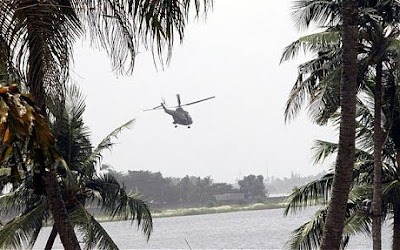
On 24 December 1999 what started as a pay mutiny by these same disaffected troops morphed into a coup d’etat, and by 2002 had become a full-blown civil war. At that time my unit was sent in to get 2700+ Americans and other nationalities out of the rebel-held north. What we saw last week - French and UN helicopters firing missiles into the President’s residence in Abidjan - was the culmination of events that kicked off in 1999.
The current set of circumstances Cote d’Ivoire relate directly to national elections held in October of last year. Despite losing the election, Laurent Gbagbo refused to step down, never mind the fact that his term in office expired five years ago; he simply refused to leave.
His opponent, Alassane Ouattara, has the support of world leaders, but not of Ivory Coast's military. And so associated himself with the rebel faction, which slowly but surely made its way toward the capital in an almost symbolic combat that claimed less than 500 lives.
Road to War:
In the years leading up to the coup of ’99, the government of President Bédié had drifted toward a xenophobic policy described as “Ivoirité”: the exclusion of immigrant workers from Mali and Burkina Faso, some of whom had been in the country for generations. Ouattara’s father’s side of the family is from Burkina Faso – a fact that confounded Ouattara’s earlier political activities - and so much of the exploited underclass was able to identify with him and the rebel forces that emerged since the civil war of ’02. Another complication in this conflict is the cultural fault line between Muslims in the north, and the Christian majority of the economically prosperous south.
In North America it is difficult to fully appreciate these kind of issues, of course, and all this past month the thing in Libya has eclipsed the situation in West Africa. Oil is important, despite the fact that we could straight up buy the oil from the Libyans if we wanted to – or anyone else - any day of the week, or we can drill for it ourselves. But Cote d’Ivoire has something unique that can’t be found in deserts, arctic regions or at the bottom of the ocean.

Cote d’Ivoire produces almost 50% of the world’s supply of cocoa beans, and the beans have been piling up in the warehouses. There is coffee there as well, and rubber plantations. The rebels say they are fighting for their national identity, but their cause was financed by the power of the beans.
Autumn Return
In September of 2002 my outfit got the word we were going down to the Ivory Coast to evacuate Americans. Normally for this sort of thing the phone rings in the dead of night, you roll over, “Honey, I’m going to be out of town for a couple of weeks.” She says, “Whatever,” and you get a little break from each other’s company.
This time “the balloon went up” at ten in the morning. We immediately went into mission prep, dragged our kit bags, drew our weapons and blew out of there – phone calls to mama-san were out of the question; OPSEC. My wife and kids – ALL the wives and kids – didn’t know where we were for the better part of two weeks.
We flew into Yamousoukro and established ourselves in the airport firehouse – a cement lean-to at the drainage end of the runway. The place was infested with mosquitos. I have lived and worked in the tropics most of my life and I have never seen mosquitos that bad; at one point I looked down at my exposed forearm and it looked like I had black fur. I wiped the insects away and my skin was dripping red with blood.

The American refugees assembled at the International Christian Academy in Bouaké. The rebels were having a firefight with the Loyalists; the French Foreign Legion were pulling security in their LAVs (Light Armored Vehicles) and their gun jeeps. The Loyalists would fall back through the Legion’s lines, the Legion would open up on the rebels, the rebels would fall back and the Loyalists would advance; rinse and repeat.
The people we evacuated were mostly missionaries who’d lived there for years. They left everything behind; they were allowed one bag each. We rolled up there in our “GunVees” (modified HumVees bristling with belt-fed weapons), pulled security while the Americans loaded up in school buses, then escorted them back to the airport at Yamoussoukro.

American refugees escorted by American Special Forces, Ivory Coast, September 2002.

The scene at the airport was equally sad; I saw a Frenchman roll up in his Renault, hop out and say to an African standing nearby, “You want a car?” Then he simply handed over the keys.
At one point I was interviewed by an American intelligence officer. “You’ve been here before? You trained the rebels?”
“That’s right.” I told him about our activities in Akuedo, in 1999.
He asked me what kind of troops they were, their capabilities. I told him that if ever you come under fire from them, the safest place to be is right out in the middle of the road.
“HUH?”
“They can’t hit the broad side of a barn, from the inside.”
He opened up a laptop and showed me photographs of the rebels taken in Bouaké and Korhogo. “Do you recognize any of these guys?”
“Well, they all look the same, but yes I do. That guy’s name is Valere.”
“YOU KNOW HIS NAME?”
“We used to drink beer and play cards together.”

“What about this guy?”
“That’s Ironman.”
Like all military operations, there was a lot of “hurry-up-and-wait”. I spent an afternoon in an air-conditioned van with an older American gentleman and his wife. She had a strange accent I couldn’t quite put a finger one. To fight boredom I started impersonating the French officers – in French; the wife was going into hysterics, ringing out peals of laughter. Turned out she was Québécois, which explained a lot of things, and he was the “OGA” station chief, which explained even more.
Later, after we returned to Stuttgart, I learned from an Ivoirian I’d stayed in touch with that my buddy Valere was indeed with the rebel forces. It turned out he was killed in action - in Bouaké, the day of the evacuation.
Epilogue:
In February of 2003 I attended a briefing at Special Operations Command, Europe (SOCEUR), in Stuttgart. The officer opened the briefing with, “It’s coup season again down in Africa.” A small team was put on alert to go down to “CDI”, to perform reconnaissance tasks, prepare assembly areas for an evacuation, etcetera. We were told to pack our bags and be ready to launch; the specific guidance was: “Be within one hour of sobriety.”
While waiting for the balloon to go up, my journalist brother emailed me that he would be passing through Frankfurt, headed for an embed slot with the 3d Infantry Division for the then-anticipated invasion of Iraq - could we meet up?
At first I told him I couldn't make it – I was on a one hour string. Then it occurred to me that I was instrumental in my brother’s circumstances - in January I'd made a phone call that got him into the embed program – and if something terrible happened, I would never forgive myself, not seeing him when I had the chance. I had to go, so I called the officer over at SOCEUR. “Can you be back here within one hour?” Sure thing, I told him; normally it’s an hour and a half ride up there, but you can fly over those German autobahns. Never mind the fact there was about an inch of ice all over everything.
My brother and I linked up in the airport - he finagled his way through Customs to get out of the transit lounge. We had a good German breakfast of sausages and beer and joked about how it would be his last beer for a long time. Afterwards we strolled through the side of the airport which is like a giant shopping mall, and I pointed out the escalators to the S-bahn, the trains that go everywhere in Germany. It was still dark outside when my phone went off; all my brother heard was me saying, “Yes sir . . . uh-huh . . . yes sir . . . I’ll be there. I’m enroute.”
I looked up and my brother was grinning from ear to ear; he’d just seen me get THE PHONE CALL. We said our goodbyes and he went his way and I went mine. Two brothers, linking up in Europe, heading in two separate directions to two different wars, on two different continents. Much later my brother described the scene: “It was like being in London, 1942.”
My brother went to the Sandpile and took part in the Great and Glorious War on Terror; I parked my car in front of a gray, non-descript building in a military compound in Stuttgart, went inside and grabbed my kit bag, got on a C-130 and made my way back down to an obscure little war in Africa, in a country most people can’t even find on a map.
SEAN LINNANE SENDS

MMB HERE
.
Africa is tribal. I saw this in the Ivory Coast – le Cote d’Ivoire – when I was there as a military advisor in 1999. I would tell the Ivorian officer where & when I needed his men, or where to go to next; he would turn around and give a command and half the platoon would tighten up and look alert like proper soldiers. The other half would look down at the ground and shuffle their feet, a lot of attitude and body language. I figured it out real fast; half the platoon was his tribe, Ashanti, the “shuck-and-jive” crowd was of the other tribe; Twee, or Ibo.
On 24 December 1999 what started as a pay mutiny by these same disaffected troops morphed into a coup d’etat, and by 2002 had become a full-blown civil war. At that time my unit was sent in to get 2700+ Americans and other nationalities out of the rebel-held north. What we saw last week - French and UN helicopters firing missiles into the President’s residence in Abidjan - was the culmination of events that kicked off in 1999.

French helicopter attack sortie toward the Presidential Residence in Abidjan, Cote d'Ivoire, April 2011.
The current set of circumstances Cote d’Ivoire relate directly to national elections held in October of last year. Despite losing the election, Laurent Gbagbo refused to step down, never mind the fact that his term in office expired five years ago; he simply refused to leave.
His opponent, Alassane Ouattara, has the support of world leaders, but not of Ivory Coast's military. And so associated himself with the rebel faction, which slowly but surely made its way toward the capital in an almost symbolic combat that claimed less than 500 lives.
Road to War:
In the years leading up to the coup of ’99, the government of President Bédié had drifted toward a xenophobic policy described as “Ivoirité”: the exclusion of immigrant workers from Mali and Burkina Faso, some of whom had been in the country for generations. Ouattara’s father’s side of the family is from Burkina Faso – a fact that confounded Ouattara’s earlier political activities - and so much of the exploited underclass was able to identify with him and the rebel forces that emerged since the civil war of ’02. Another complication in this conflict is the cultural fault line between Muslims in the north, and the Christian majority of the economically prosperous south.
In North America it is difficult to fully appreciate these kind of issues, of course, and all this past month the thing in Libya has eclipsed the situation in West Africa. Oil is important, despite the fact that we could straight up buy the oil from the Libyans if we wanted to – or anyone else - any day of the week, or we can drill for it ourselves. But Cote d’Ivoire has something unique that can’t be found in deserts, arctic regions or at the bottom of the ocean.

Carrying cocoa beans in the port of San Pedro, Ivory Coast; much of the
nation's economy depends on the exports. (Jane Hahn / New York Times)
Cote d’Ivoire produces almost 50% of the world’s supply of cocoa beans, and the beans have been piling up in the warehouses. There is coffee there as well, and rubber plantations. The rebels say they are fighting for their national identity, but their cause was financed by the power of the beans.
Autumn Return
In September of 2002 my outfit got the word we were going down to the Ivory Coast to evacuate Americans. Normally for this sort of thing the phone rings in the dead of night, you roll over, “Honey, I’m going to be out of town for a couple of weeks.” She says, “Whatever,” and you get a little break from each other’s company.
This time “the balloon went up” at ten in the morning. We immediately went into mission prep, dragged our kit bags, drew our weapons and blew out of there – phone calls to mama-san were out of the question; OPSEC. My wife and kids – ALL the wives and kids – didn’t know where we were for the better part of two weeks.
We flew into Yamousoukro and established ourselves in the airport firehouse – a cement lean-to at the drainage end of the runway. The place was infested with mosquitos. I have lived and worked in the tropics most of my life and I have never seen mosquitos that bad; at one point I looked down at my exposed forearm and it looked like I had black fur. I wiped the insects away and my skin was dripping red with blood.

American Special Forces at Yamassoukro Airport, Cote d'Ivoire, September 2002.
The American refugees assembled at the International Christian Academy in Bouaké. The rebels were having a firefight with the Loyalists; the French Foreign Legion were pulling security in their LAVs (Light Armored Vehicles) and their gun jeeps. The Loyalists would fall back through the Legion’s lines, the Legion would open up on the rebels, the rebels would fall back and the Loyalists would advance; rinse and repeat.
The people we evacuated were mostly missionaries who’d lived there for years. They left everything behind; they were allowed one bag each. We rolled up there in our “GunVees” (modified HumVees bristling with belt-fed weapons), pulled security while the Americans loaded up in school buses, then escorted them back to the airport at Yamoussoukro.

American refugees escorted by American Special Forces, Ivory Coast, September 2002.

(That's me you can see through the windshield of the bus.)
The scene at the airport was equally sad; I saw a Frenchman roll up in his Renault, hop out and say to an African standing nearby, “You want a car?” Then he simply handed over the keys.
At one point I was interviewed by an American intelligence officer. “You’ve been here before? You trained the rebels?”
“That’s right.” I told him about our activities in Akuedo, in 1999.
He asked me what kind of troops they were, their capabilities. I told him that if ever you come under fire from them, the safest place to be is right out in the middle of the road.
“HUH?”
“They can’t hit the broad side of a barn, from the inside.”
He opened up a laptop and showed me photographs of the rebels taken in Bouaké and Korhogo. “Do you recognize any of these guys?”
“Well, they all look the same, but yes I do. That guy’s name is Valere.”
“YOU KNOW HIS NAME?”
“We used to drink beer and play cards together.”

Valere
“What about this guy?”
“That’s Ironman.”
Like all military operations, there was a lot of “hurry-up-and-wait”. I spent an afternoon in an air-conditioned van with an older American gentleman and his wife. She had a strange accent I couldn’t quite put a finger one. To fight boredom I started impersonating the French officers – in French; the wife was going into hysterics, ringing out peals of laughter. Turned out she was Québécois, which explained a lot of things, and he was the “OGA” station chief, which explained even more.
Later, after we returned to Stuttgart, I learned from an Ivoirian I’d stayed in touch with that my buddy Valere was indeed with the rebel forces. It turned out he was killed in action - in Bouaké, the day of the evacuation.
Epilogue:
In February of 2003 I attended a briefing at Special Operations Command, Europe (SOCEUR), in Stuttgart. The officer opened the briefing with, “It’s coup season again down in Africa.” A small team was put on alert to go down to “CDI”, to perform reconnaissance tasks, prepare assembly areas for an evacuation, etcetera. We were told to pack our bags and be ready to launch; the specific guidance was: “Be within one hour of sobriety.”
While waiting for the balloon to go up, my journalist brother emailed me that he would be passing through Frankfurt, headed for an embed slot with the 3d Infantry Division for the then-anticipated invasion of Iraq - could we meet up?
At first I told him I couldn't make it – I was on a one hour string. Then it occurred to me that I was instrumental in my brother’s circumstances - in January I'd made a phone call that got him into the embed program – and if something terrible happened, I would never forgive myself, not seeing him when I had the chance. I had to go, so I called the officer over at SOCEUR. “Can you be back here within one hour?” Sure thing, I told him; normally it’s an hour and a half ride up there, but you can fly over those German autobahns. Never mind the fact there was about an inch of ice all over everything.
My brother and I linked up in the airport - he finagled his way through Customs to get out of the transit lounge. We had a good German breakfast of sausages and beer and joked about how it would be his last beer for a long time. Afterwards we strolled through the side of the airport which is like a giant shopping mall, and I pointed out the escalators to the S-bahn, the trains that go everywhere in Germany. It was still dark outside when my phone went off; all my brother heard was me saying, “Yes sir . . . uh-huh . . . yes sir . . . I’ll be there. I’m enroute.”
I looked up and my brother was grinning from ear to ear; he’d just seen me get THE PHONE CALL. We said our goodbyes and he went his way and I went mine. Two brothers, linking up in Europe, heading in two separate directions to two different wars, on two different continents. Much later my brother described the scene: “It was like being in London, 1942.”
My brother went to the Sandpile and took part in the Great and Glorious War on Terror; I parked my car in front of a gray, non-descript building in a military compound in Stuttgart, went inside and grabbed my kit bag, got on a C-130 and made my way back down to an obscure little war in Africa, in a country most people can’t even find on a map.
SEAN LINNANE SENDS

MMB HERE
.
Subscribe to:
Posts (Atom)