Showing posts with label 10th Special Forces Group. Show all posts

Thursday, June 30, 2011

EX-SPECIAL FORCES MEMBERS DROP IN

This is my old outfit . . . of course, I wasn't in Vietnam, and I didn't do what these guys did. They are the type of heroes who were still serving as Platoon Sergeants, First Sergeants when I was a private. When I got to Special Forces, they were the Team Sergeants, Sergeants-Major, and crusty old Warrant Officers - S.L.


by Nick Stubbs
MacDill AFB Thunderbolt

6/23/2011 - MacDill Air Force Base, Fla. - In the steamy jungles of Vietnam in 1957, nearly eight years before America began major combat operations there, members of the U.S. Army's 1st Special Forces Group (Airborne) were in country, advising and training indigenous warriors.

It was all on the down-low, as were all missions until the end of the war. Secrecy is stock and trade of the Green Berets, after all.


Flags proudly wave over the United States Special Operations Command Memorial Plaza during a memorial service in which members of the 1st Special Forces Group Reunion honored their fallen comrades, at MacDill Air Force Base, Fla., June 20, 2011. The memorial service included a moment of silence and a tribute to fallen members of 1st Special Forces Group from Viet Nam through Operation Enduring Freedom (Philippines and Afghanistan) and Operation Iraqi Freedom. (U.S. Air Force photo by Airman Basic David Tracy)

But it was no secret in Tampa this week when some 200 veterans of the famous unit gathered for a ceremony at U.S. Special Operations Command at MacDill Air Force Base Monday. Arriving in town over the weekend, the group of old soldiers staged at the DoubleTree Hotel at Rocky Point. It was a time to remember, laugh and shed a tear or more for those who were lost.

Formed at Camp Drake, Japan, June 24, 1957, 1st SFG served in the Pacific region and provided some of the first American military members to serve in Vietnam. It wouldn't be until 1965 when major combat operations would begin, sending many members of the 1st on very dangerous missions well behind enemy lines.

How far behind lines?

"We were the front line - sometimes 70 miles behind what they called the front line," said retired Master Sgt. David Kauhaahna, who joked that his special forces code name is "Brother K."


Retired Lt. Col. Keith Walter, Lt. Col. Jim Bean and Retired Sgt. Maj. Russ McDaniel, members of the United States Special Operations Command Parachute Team, The Para-Commandos, descend toward the 1st Special Forces Group Reunion memorial service. Sergeant Major McDaniel flew the POW/MIA flag behind him during the descent which was presented to former prisoner of war Isaac “Ike” Camacho. (U.S. Air Force photo by Airman Basic David Tracy)


He arrived in country November of 1965, and served in Laos among other places. Like most others of the 1st, he operated in small units, usually just six men. Three of them might be indigenous Montagnards, or mountain people who earned a reputation as some of the toughest warriors and expert jungle guides in the country.

Being so far behind lines, and with support far away, there was always the risk of not making it through any mission.

"Lots," said Sergeant Kauhaahna of close brushes he had with death. "Lots of times."
One sticks out in his memory.

"We were surrounded by enemy, and they had set the elephant grass on fire and it was closing in on us," he recalled. "We thought that was it for us, but helicopters got there just in time to pull us out; we would have been slaughtered."


Isaac "Ike" Camacho, Vietnam POW that escaped from his capture, receives a POW/MIA flag from Command Sgt. Maj. Thomas Smith, United States Special Operations Command, during the 1st Special Operation Group annual reunion at MacDill Air Force Base, June 20, 2011


Close calls were part of the job, said retired Sgt. Major Billy Waugh, who served just shy of eight years in Vietnam, and has a Purple Heart for all eight (along with a Legion of Merit, a Silver Star and four Bronze Stars).

"A lot of what we were doing was directing air strikes (targeting and surveillance as members of the Studies and Observation Group)," said Sergeant Waugh, who recalled that the U.S. Air Force fighters and bombers evolved into being "very effective" at tactical air strikes during his years of service. "They took a little while to get the hang of it, but once they did, they did a heck of job."

When not performing SOG duties, "Our job was to kill and destroy," said Sergeant Waugh.

Members of the 1st were invaluable to downed pilots in need of rescue behind enemy lines.

"We were the only guys there, so we did the job," said Sergeant Waugh.

The memories fill volumes, and are only outnumbered by the close kinships members of the historical group share, said Sergeant Waugh, which is why the reunions are regularly held. This year's event marks the first in Tampa, and a special one in that it was in the same town as MacDill Air Force Base and SOCOM.

"We are glad we could gather here this time," Sergeant Waugh said. "It's a sort of coming together."


Today's Bird HERE


.

Tuesday, February 15, 2011

SPECIAL FORCES SERGEANTS MAJOR DON GREEN BERET ONE LAST TIME

By Master Sgt. Donald Sparks, Special Operations Command, Europe

Feb 8, 2010


Photo credit Master Sgt. Donald Sparks

Sergeants Major Brian Bushong (left), and Larry Reeb, 1st Battalion, 10th Special Forces Group (Airborne), listen to Barry Sadler’s ‘Ballad of the Green Beret’ during their retirement ceremony January 21.


STUTTGART, Germany - Twenty-five years ago, two men joined the Army one week apart at different locations. Nineteen years ago, they both became Special Forces sergeants. Earlier this year, they finished their careers together as brothers-in-arms and leaders in the SF community.

Sgts. Maj. Brian Bushong and Larry Reeb bid farewell to their fellow Green Beret brethren of 1st Battalion, 10th Special Forces Group (Airborne) during a retirement ceremony held Jan. 21 in Panzer Hall.

Maj. Gen. Michael S. Repass, commander, U.S. Army Special Forces Command (Airborne), praised the two warriors for their distinguished service.

"When you joined the Army, you were given a check to serve, to go in harm's way and to do the nation's business," Repass said. "You've cashed in with your service and commitment to our nation."

Bushong, a former anti-tank gunner, decided to become a Special Forces Soldier because he wanted more of a challenge and also because he was inspired by members of his family who served honorably in World War II and the Korean War.

"My father shared his experiences of combat from his time in Korea," said Bushong. "The heroes who served as part of the 'Greatest Generation' were my uncles, and they inspired me."

Reeb, who described himself as, "nothing more than a poor son of a mountain man from Kentucky," originally joined the Army as a crew chief on a UH-60 helicopter. In 1987, during a support mission in Beirut, his bird hauled a Special Forces team to a location and he said, "I want to be one of them.

"I could tell they were a tight, focused, camaraderie team and that appealed to me," he added. He earned his green beret in 1991 as well, and became a Special Forces communications sergeant.

Both men recalled their many operational contributions to missions all over the world.

Bushong took part in Operation Assured Response in 1996, evacuating nearly 1,000 Americans and embassy personnel from Monrovia, Liberia.

"It was a very hostile environment," he said. "Normally, we don't get to do missions for our own people, but having the opportunity to protect our own citizens and protecting their lives meant a lot to me. I still have a sense of satisfaction from what we did."

Reeb mentioned that the personal highlight of his career was deploying with his company to Afghanistan and returning from deployment with all of his men. Ten of his Soldiers earned Purple Hearts during their tour of duty.

"I went out on every mission with those men," Reeb said. "As a company sergeant major, I can truly say those men motivated me."

At the end of the ceremony, both men faced the next generation of warriors who proudly wear the green beret, while listening to the Ballad of the Green Beret echoing throughout the center.

"We all have that certain kind of DNA," Bushong said of Special Forces Soldiers, with a grin. "It's no coincidence of who we are and what we do."


I served with both these men - they are both honorable and worthy, and I'm glad to see they made it to Sergeant Major. One thing I will tell you is that Reeb character scared me more than any bad guy I ever faced down - he's that crazy and I say that in a good way - and that's the God's Honest Truth.

SEAN LINNANE SENDS


.

Saturday, January 22, 2011

RoKs TO THE RESCUE

South Korean forces storm hijacked ship, free hostages:


South Korean special forces staged a dramatic pre-dawn rescue of 21 seamen who had been hijacked by Somali pirates. Military commandos boarded the vessel owned by Korean chemical carrier Samho Jewelry under the cover of darkness and went through the ship systematically. Pirates shot the ship's captain during the ensuing melee, but his wounds were not life threatening. Commandos killed eight pirates and arrested five. The rescue was good news for South Korean president Lee Myung-bak, who is under fire for his perceived weak responses to two acts of North Korean aggression last year.


There should be more of this sort of thing . . . . . . Saturday Bird HERE


.

Friday, August 14, 2009

NAVAL AIR OPERATIONS IN AFGHANISTAN

From:
Date: 6/13/2009 8:05:51 PM
To:
Subject: Naval Air Operations in Afghanistan


This is me in the cockpit and my large Martian helmet. The weapon that is out on the right wing of the aircraft is a 500-lb laser guided bomb. On the other wing that you can't see is a 500-lb GPS guided bomb. That is our standard load out on these missions.


Hello everyone,

I just wanted to send another update to let you know how things are going out here on the good ship USS Eisenhower. We're in our seventh week of deployment and have 108 days to go. We began combat operations on March 21st and have been flying over the beach almost every day since then. This is the most flying that I've done in all my 17 years. Naval aviators are limited by instruction to 30 flight hours a month and, to exceed that, you must have a written waiver by the Flight Surgeon. As of today I have 65 hours in the last 29 days.

Our missions are regularly 6 hours long. Its an hour transit to and from the ship just to get on station in southern Afghanistan . All the air traffic travels up a common air route that we call The Boulevard that traverses Pakistan and crosses the border into Afghanistan. All the traffic on the boulevard is either Naval aircraft from our ship or Air Force tankers coming from Qatar.

Most of our missions thus far have been in southern Afghanistan near the city of Kandahar. That is where a lot of the poppy harvest is taking place right now and that is where a lot of the enemy forces are dug in. On a typical mission, we check in with a Joint Tactical Air Controller (JTAC) on the ground who is part of a ground unit. The JTAC is trained to communicate with aircraft and if necessary call in for air support in case some shooting starts. They used to be called Forward Air Controllers.

Thus far I have worked with American Special Forces, British Forces, Australian and Danish Forces. It is very interesting to see the mix of troops on the ground. But its nice to see that all the procedures are very standardized no matter what nationality that you are supporting. On most of our missions we provide Armed Reconnaissance, which has us watching over a friendly ground patrol, in vehicle or on foot, and looking ahead of their route of travel to try and find enemy fighters or potential spotting positions.

A few days ago I was watching over an Army Special Forces unit. There were about 15 to 20 guys all riding four wheelers in the hills overlooking a small village. We do most of our searching using our FLIR camera which is an infrared camera that has the ability to zoom in pretty close. The JTACS on the ground can also link up with our FLIR camera and see what we are seeing on their laptop computer.

We look for bad guys in groups digging or potentially placing roadside bombs. A lot of times the JTACS give us coordinates of known bad-guy locations and have us watch for movement or activity.

A few nights ago I was talking to a JTAC and I could hear the gunfire over the radio and he calmly said they were taking fire from an unknown locations and wanted us to scan the hills surrounding them for any activity. On average our Air Wing drops four or five bombs a day or conducts a few strafing runs on enemy positions.

We also do a lot of Shows of Force which is simply a high speed low-altitude pass over an enemy position to get them to stop shooting or even run. Although I haven't yet gotten a chance to drop a bomb, I can say that I'm not in a rush. My time will come. I did have a wingman who conducted a strafing run on two individuals who were digging at a roadside intersection. It was at night so the complexity of shooting bullets from an aircraft moving 500mph at a small moving target in the dark is absolutely amazing.

I enjoy working with the guys on the ground. I think it’s a comforting feeling for them to know that we are overhead and can deliver a devastatingly accurate blow within seconds of asking for it. Even if we don't find bad guys, I feel a lot of job satisfaction just being up there and talking to the guys on the ground. These guys are pretty amazing. I will hear them say something like, "We are taking fire from an unknown location so we are going to get out of our vehicles and move into the open so we can try to locate where the fire is coming from." Amazing bravery. Our team is killing a lot of bad guys right now.

Some of the most harrowing parts of our mission is refueling . . . particularly in the dark or in bad weather. On a typical 6-hour mission, we refuel off of big wing Air Force tankers three times.
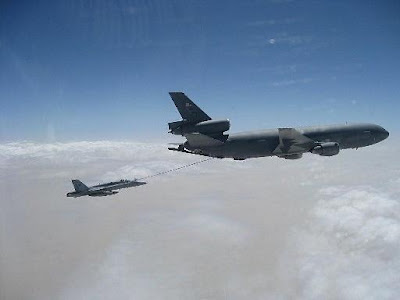

This is my wingman tanking from an Air Force KC10.

There is a point on the boulevard that once I cross it I know that if I have a problem with my tanker, that I do not have enough fuel to get back to the carrier and would have to divert to one of the three occupied airfields in the country. The tankers all hold at specific points and altitudes around the country.

I know before I launch what my tanker's call sign is, what point he will be at, what time I'm supposed to be there, what altitude he will be at and what frequency I will talk to him on. There is an overarching control agency that runs the tanker plan and it is constantly changing usually based on the fight that is going on the ground. A lot of times tankers get pushed over an area where there is fighting so that the airborne assets don't waste time trying to get to their tanker and back into the fight. Once one tanker moves it starts a domino effect that effects almost everyone. Its like a shell game. They are constantly shuffling tankers around. I don't think I've launched on a single mission and hit all my tankers that I was originally scheduled for. I have tanked off American and British Air Force tankers.

Two days ago I was on a tanker and two French Rafael fighters were waiting in line with me at 22000 feet for their gas. When the mission is over we hit the tanker one last time before exiting the country and fly the boulevard south and the hour flight back to the carrier. When its all done then I get to look forward to that night carrier landing.

Luckily the North Arabian Sea is calm and the weather has been good. No pitching deck out here so far. By the end of the mission I'm usually starving. I try and take food and water with me in the cockpit and typically I get a chance to eat and drink something on the trip back to the carrier at the end of the mission. But you don't want to drink too much because that presents a whole new problem for a single seat cockpit.

Thank goodness for altitude hold. The cockpit gets pretty crowded with all of our extra gear. We have our standard issue gear for going in country which includes our pistol and two magazine clips, our blood chit which is basically a piece a paper that we use in case we find ourselves on the ground that is written in several different native languages and basically says "I'm an American and you will be paid if you help me return to friendly American forces." We carry a camelback* full of water that is sewn into our flight vest.

* plastic collapsable bladder with drinking tube, commonly worn on the back - S.L.

On every mission we go on, we have a stack of papers that have coordinates and radio frequencies. I also have my new helmet-mounted targeting system which is a new visor that clips to the regular helmet and projects vital information on my visor (I've attached a picture of me wearing that helmet in the cockpit.) It looks like a Martian helmet, but it is honestly the best piece of gear that I carry with me. I can type in the coordinates for a friendly unit on the ground and then look outside the cockpit and diamond will be projected on my visor directly over the position of that unit on the ground. It's very useful in locating things on the ground, but it also helps me find things in the air.

Yesterday I saw my tanker from 28 miles away because my helmet puts a box around the radar contact that I have locked up so I know exactly where to look. Pretty cool. I also take a pair of NVGs on every flight. Night-vision goggles are absolutely necessary once the sun goes down. The ground units use a lot of infrared lights to help mark their positions or the positions of enemy units and I can see all of that from 20000 feet with my NVG's on.

Well I've written way more than I should have. I hope I haven't bored you. I know many of you have asked what I'm doing over here. This email was to try to help you understand what I've been doing. It in no way is meant to be tooting my own horn.. The guys on the ground are the real heroes. I'm simply a supporting element to the fight.

I want to say thank you to all of you who have sent Care packages. They were very much appreciated by me and all the guys in my ready room. Keep watching the news. If you hear about airstrikes in Southern Afghanistan there is a good chance it came from my Air Wing.

This is me flying in Aircraft 401 taken two days ago.
Sunday, June 21, 2009

ROGERs RANGERS - STANDING ORDERS


Rogers Rangers was an unconventional fighting force stood up in the (then) British Colonies of North America, to fight the French and their Indian allies in the Seven Years War, a.k.a. the French and Indian War. Modern US Special Forces and Ranger units trace their lineage directly to this organization.


Standing Rules of ROGERS' RANGERS

1. DON'T FORGET NOTHIN'.

2. Keep your musket clean as a whistle, hatchet sharp and scoured, sixty rounds powder and ball, and be ready to march at a minute's warning.

3. When you’re on the march, act the way you would if you were sneaking up on a deer. See the enemy first.

4. Tell the truth about what you see and do. There is an army depending on you for correct information. You can lie all you please when you tell other folks about the Rangers, but never lie to another Ranger or to an officer.

5. Don't ever take a chance you don't have to.

6. When we're on the march, we move in single file, staying far enough apart that one shot can't go through two men. This also helps conceal the number of men in our party.

7. If we strike swamps or soft ground, we spread out abreast so it's harder to track us.

8. When we’re on the march, we keep moving until dark to give the enemy the least possible chance at catching up to us.

9. When we make camp, half the party stays awake while the other half sleeps.

10. If we take prisoners, we keep them separated until we have time to examine them, so they can't cook up a story between them.

11. We never return home the same way we went out. We use a different route, so we won't be ambushed. Be extra careful when we get close to home: the enemy may be
lying in wait nearby.

12. Whether we travel in big parties or little ones, each party keeps a scout 20 yards ahead, 20 yards on each flank and 20 yards in the rear, so the main body can't be surprised and wiped out.

13. Every night, you'll be told where to meet if we have to disperse to avoid being surrounded by a superior force.

14. Never sit down to eat, or stop to replenish water supplies, without posting sentries.

15. All hands shall be awake, alert and ready for action before dawn. Dawn's when the French and Indians like to attack.

16. If we find that somebody's trailing us we make a circle, come back on our own tracks, and ambush the folks that aim to ambush us.

17. When we’re on the march, we stay at least a hundred yards away from lakes or rivers, to avoid being trapped against a shoreline.

18. Never cross a river by a known, regular ford. These are prime places for ambush.

19. Don't stand up when the enemy's coming against you. Kneel down, or hide behind a tree or rock.

20. Let the enemy come till he's almost close enough to touch. Then let him have it, jump out and finish him with your hatchet.

To this day, these rules are found in the US Army Ranger Handbook, and are posted on barracks walls of every Infantry unit in the US Army.

Sunday, May 24, 2009

HEROES


Profiles of Valor: 10th Special Forces Group

On 10 September 2007, a team of three Army Green Berets led by Capt. Matthew A. Chaney, along with nine Iraqi police, began an assault from two helicopters near Samarra, Iraq. The team was targeting Abu Obaeideah, a leader of the Islamic State of Iraq in the area. The field designated for landing was covered with water, so the helicopters had to land closer to the insurgents' safe house, where they came under heavy enemy fire.

Practically blinded by dust from the second helicopter, the Iraqis were all but taken out of the fight from the start, so Chaney, Sgt. 1st Class Michael D. Lindsay and Staff Sgt. Jarion Halbisengibbs led a charge against the building where the hostile fire was originating. Halbisengibbs threw in a fragmentation grenade, killing two, and the soldiers rushed in. Lindsay was hit in the throat by an AK-47 round, and Chaney took a hit to the pelvis. Then both were thrown from the doorway by a grenade blast. Lindsay, who couldn't raise his rifle, fired at the enemy with his pistol. Chaney couldn't feel his legs, but he kept firing, killing a jihadi.

Halbisengibbs "continued to clear the structure in complete darkness as his night vision goggles and personal radio were all destroyed by enemy gunfire at point blank range," the official narrative read. He was shot in the thumb and knocked down by a grenade blast but continued fighting, killing another terrorist. As he moved back to the courtyard to protect his wounded comrades, Halbisengibbs was shot through the abdomen but managed to kill another jihadi on his way to the ground. He then directed the Iraqi police to finish the fight. Obaeideah was killed, along with 12 other insurgents, six by Halbisengibbs.

All three Green Berets have recovered from their injuries. Chaney and Lindsay were each awarded the Silver Star; Halbisengibbs received the Distinguished Service Cross, the Army's second highest combat medal.