 Israeli commandos aboard the
 MV Mavi Marmara. On the lower-right the Flag of Turkey is visible.
The Law of Blockade was derived from customary international law and codified in the 1909 Declaration of London, and updated in 1994 in a legally recognized document called the "San Remo Manual on International Law Applicable to Armed Conflicts at Sea".
Some of the key rules: the blockade must be declared and notified to all belligerents and neutral states, access to neutral ports cannot be blocked, and an area can only be blockaded which is under enemy control.
According to Philip Roche, partner in the shipping disputes and risk management team with law firm Norton Rose: "On the basis that Hamas is the ruling entity of Gaza and Israel is in the midst of an armed struggle against that ruling entity, the blockade is legal."
INTERNATIONAL WATERS
Under the U.N. Convention of the Law of the Sea a coastal state has a "territorial sea" of 12 nautical miles from the coast over which it is sovereign. Ships of other states are allowed "innocent passage" through such waters.
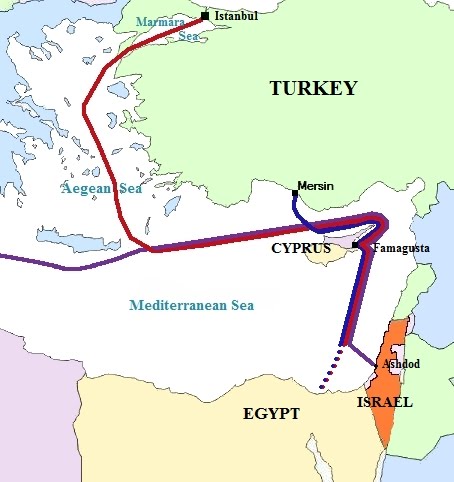 Route of the flotilla
There is a further 12 nautical mile zone called the "contiguous zone" over which a state may take action to protect itself or its laws.
Beyond the 12 nautical miles limit the seas are the "high seas" or international waters.
The Israeli Navy said on Monday that the Gaza bound flotilla was intercepted 120 km (75 miles) west of Israel. The Turkish captain of one of the vessels told an Istanbul news conference after returning home from Israeli detention they were 68 miles outside Israeli territorial waters.
Under the law of a blockade, intercepting a vessel could apply globally so long as a ship is bound for a "belligerent" territory, legal experts say.
 MV Mavi Marmara leaving Antalya for Gaza on 22 May 2010 Source: Free Gaza Movement
USE OF FORCE WHEN INTERCEPTING SHIPS
Under International Law a nation can use force when boarding a ship.
"If force is disproportionate it would be a violation of the key tenets of the use of force," said Commander James Kraska, professor of international law at the U.S. Naval War College.
Israeli authorities said marines who boarded the Turkish vessel Mavi Marmara opened fire in self-defense after activists clubbed and stabbed them and snatched some of their weapons.
Legal experts say proportional force does not mean that guns cannot be used by forces when being attacked with knives.
"But there has got to be a relationship between the threat and response," Kraska said.
The use of force may also have other repercussions.
"While the full facts need to emerge from a credible and transparent investigation, from what is known now, it appears that Israel acted within its legal rights," said J. Peter Pham, a strategic adviser to U.S. and European governments.
"However, not every operation that the law permits is necessarily prudent from the strategic point of view."
PIRACY
Opponents have called Israel's raid "piracy"; under international law it was considered a state action.
"Whether what Israel did is right or wrong, it is not an act of piracy. Piracy deals with private conduct particularly with a pecuniary or financial interest," Kraska said.
EFFECTS ON INTERNATIONAL SHIPPING
None so far but the International Chamber of Shipping (ICS), an association which represents 75 percent of the world's merchant fleet, has expressed "deep concern" over the boarding by Israeli forces, arguing that merchant ships have a right to safe passage and freedom of navigation in international waters.
"These fundamental principles of International Law must always be upheld by all of the world's nations," the ICS said.
 Don't worry Israel - STORMBRINGER has "got your six"!
.