Tuesday, July 21, 2009

"We Choose the Moon . . ."


Check out this cool website: wechoosethemoon.org

An inter-active recreation of the first mission to the moon, presented by the JFK Presidential Library.

Monday, July 20, 2009

SANITY PREVAILS TEMPORARILY


Treasury Cancels Plans to Hire Cartoonist - AP

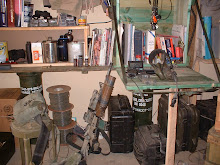
Good to see somebody somewhere finally grew a brain. I love cartoons, especially underground comics and the stuff that used to show up on workplace bulletin boards (above) before the advent of the Internet and the PC Police I mean Human Resources. Cartoon humor has to be legit, homegrown and valid to produce a chuckle; this Government brainstorm would have produced strained humor at best, the end result would have had an Orwellian edge: "This sh*t IS funny & you WILL laugh at it!!!"

WE TRAINED HARD . . .


Somewhere around here I've got a folder full of quotes and cartoons I collected from all the years I spent in SF. This is one of my favorites:

“WE TRAINED HARD . . . BUT IT SEEMED THAT EVERY TIME WE WERE BEGINNING TO FORM UP INTO TEAMS WE WOULD BE REORGANIZED. I WAS TO LEARN LATER IN LIFE THAT WE TEND TO MEET ANY NEW SITUATION BY REORGANIZING; AND A WONDERFUL METHOD IT CAN BE FOR CREATING THE ILLUSION OF PROGRESS WHILE PRODUCING CONFUSION, INNEFFICIENCY, AND DEMORALIZATION.”
- Gaius Petronius Arbiter, (circa 27–66 AD)


STORMBRINGER SENDS

Sunday, July 19, 2009

YOU ARE NOT FORGOTTEN

UPDATE 21 JUL 09: The captured American soldier depicted in this Taliban video has since been identified - Pfc. Bowe Bergdahl of Hailey, Idaho, member of 1st Battalion, 501st Parachute Infantry Regiment. He is going through Hell, of course. While Bowe's family and friends go through their personal sort of living Hell, the following stories of Americans held captive overseas have faded from the front pages:


By now most of you have seen this Taliban propaganda video of an unamed American soldier, missing from his base in eastern Afghanistan June 30 and later confirmed captured. The soldier's identity has not yet been confirmed by Dept of Defense, pending notification of the soldier's family. U.S. defense officials confirmed that the man in the video is the captured soldier.


Rest assured the United States is on a full-court press to recover our soldier. Think of him as you enjoy your Sunday morning round of golf, or fishing. Remember him in your prayers at church, or temple.

Our prayers are with him.


MEANWHILE . . .


Two American journalists are still being held by North Korea.

Laura Ling and Euna Lee work for Al Gore’s California-based Current TV media group.

The two Americans were detained near the North Korean border with China and were sentenced last month to 12 years of hard labor for entering the country illegally and for “hostile acts.” North Korean officials may have been angered at the journalists for trying to produce a program critical of North Korea.


Laura Ling and Euna Lee, you are not forgotten.


North Korea may spare the US journalists from hard labor, but the two women still face awful conditions. Even if they have not yet been sent to a labor camp, they are no doubt being subjected to early morning wake up calls, daily interrogation / "re-education" sessions (that go on for unbelievable lengths of time, well into the night), minimal food of poor nutritional value, and every facet of their daily lives controlled. The worst could possibly be the stress and anxiety accompanying the fear of the unknown.

News is difficult to get out of the world's most isolated and repressed society. Their exact whereabouts remain unknown; the latest I was able to glean from open-source is that North Korea has delayed sending the two American journalists to prison labor camp.

North Korean labor camps are notorious: the horrific conditions rival that of the Third Reich, or the torture factories of Saddam Hussein's regime in Iraq. Possibly hundreds of thousands of North Koreans face starvation, filth, disease, hard labor, exposure to the elements, daily "re-education" torture sessions, summary executions and anonymous graves.

Click here to learn how you can help Laura Ling and Euna Lee.


The Korean peninsula by night.

Saturday, July 18, 2009

THIS DAY IN HISTORY: ME 262

Serious contender for the coolest airplane that ever flew, the Messerschmitt ME-262 test flew using only its jet engines for the first time 18 July 1942 in Leipheim near Günzburg, Germany, piloted by Fritz Wendel. This was almost nine months ahead of the British Gloster Meteor's first flight on 5 March 1943.


Allied pilots referred to it as the "Blow Job".


Despite engine problems in early versions, the ME-262 was way ahead of it's time. Willy Messerschmitt regarded the Me 262 as only an interim type when it went into production. The "swept wing" concept had been proposed as early as 1935; Messerschmitt researched the topic from 1940, and proposed fitting a 35° swept wing (Pfeilflügel II, literally "arrow wing II") to the Me 262, the same wing sweep angle that would later be used on both the American F-86 Sabre and Soviet MiG-15 fighter jets.

After the end of the war, the ME-262 and other advanced German technologies were quickly swept up by the Americans (as part of the USAAF's Operation Lusty), British, and Soviets. Many ME-262s were found in readily-repairable condition and were confiscated.

During post-war test flights, the ME-262 was found to have advantages over the early models of the Gloster Meteor. It was faster, had better cockpit visibility to the sides and rear (mostly due to the canopy frame and the discoloration caused by the plastics used in the Meteor's construction), and was a superior gun platform, as the early Meteors had a tendency to snake at high speed and exhibited "weak" aileron response. The ME 262 did have a shorter combat range than the Meteor.

The USAAF compared the P-80 Shooting Star and ME-262 concluding, "Despite a difference in gross weight of nearly 907 kg (2,000 lb), the ME-262 was superior to the P-80 in acceleration, speed and approximately the same in climb performance.

Survived the downfall of the Third Reich:

o Czech-manufactured variants of the ME-262 (designated AVIA S-92 and CS-92) remained in service in the Czechoslovak Air Force until 1957.

o The ME-262 is portrayed on the cover of Blue Öyster Cult’s 1974 album Secret Treaties. The song ME-262 is about a Luftwaffe pilot on a bomber interception mission in April 1945.

o Clive Cussler's famous fictional character Dirk Pitt owns an ME-262, which he acquired when he helped excavate a hidden airfield that held a number of the aircraft.

o In the PC flight-simulator Chuck Yeager's Air Combat, virtual Chuck Yeager (voiced by himself) accurately states that Allied pilots used the term Blow Job as a nickname for the ME-262.

STORMBRINGER SAVES THE BEST FOR LAST:


In January 2003, the American ME-262 Project completed flight testing to allow for delivery of near-exact reproductions of several versions of the Me 262 including at least two B-1c two-seater variants, one A-1c single seater and two "convertibles" that could be switched between the A-1c and B-1c configurations. All are powered by General Electric J85 engines and feature additional safety features, such as upgraded brakes and strengthened landing gear.

Messerschmitt Me 262B Reproduction


The "c" suffix refers to the new J-85 powerplant and has been informally assigned with the approval of the Messerschmitt Foundation in Germany (the Werk Number of the reproductions picked up where the last wartime produced Me-262 left off - a continuous airframe serial number run with a 50 year production break).

Can somebody please splice together some ME-262 footage with that Blue Öyster Cult tune, and then notify me: linnane_sean@yahoo.com - Thanks! - S.L.

COWBOY BALLAD

Most people have heard the song "El Paso" by Marty Robbins, a ballad about a cowboy and young woman named Felina. It was a very popular song back in its day , still heard today on the 'oldies' stations.

Well there is another song written by Marty Robbins that was never popular. I am sure most people don't know it even exists. It is called "Felina".


If you don't know this song "El Paso" you will not appreciate the other song "Felina".

FIRST SPECIAL FORCES GROUP

Beret flash and crest of First Special Forces Group (Airborne). The yellow denotes "Asian Gold", the black border was added to mourn the death of President John F. Kennedy, who officially recognized the Green Beret as unit distinctive headgear.


The First Special Forces Group (Airborne) was activated 20 July 1942 at Helena, Montana as Second Company, 1st Battalion, 1st Regiment, First Special Service Force. This joint Canada-American unit, known as the “Devil’s Brigade”, was intensively trained in airborne, amphibious, winter, and mountain warfare.
The soldiers of the 1st SFF distinguished themselves through daring and successful raids in both the Pacific and Mediterranean Theaters.
The Force incurred so many casualties that it became ineffective as a combat formation, and was disbanded 6 January 1945 at Menton, France.


Although not recognized in Army lineage, Detachment 101 of the Office of Strategic Services (OSS) is also considered a predecessor of 1st Special Forces Group. This unit raised and led a guerrilla force known as the “Kachin Rangers” which wrought havoc behind Japanese lines in Southeast Asia during World War II.

The modern 1st Special Forces Group was activated 24 June 1957 and stationed at Fort Buckner, Okinawa. For the next seventeen years, the Group carried out a variety of missions in the Asia-Pacific region, including civic action, foreign internal defense, counterinsurgency, reconnaissance, and disaster relief. (right) 1st SFGA Beret flash & crest, 1961-63

1st Special Forces Group saw extensive combat service in Vietnam, as well as in Laos and Thailand. Soldiers from 1st SFGA earned 296 awards for valor in Southeast Asia, and the Group was awarded the Meritorious Unit Citation. These honors were earned at a heavy price: 45 soldiers of the 1st SFGA were killed in Southeast Asia, 293 were wounded, and one remains missing in action.

1st Special Forces Group fought natural disasters as well as the enemy; teams deployed to the Philippines in 1972 and Pakistan in 1973 to provide disaster relief for victims of floods and famine. For this humanitarian service, 1st SFGA received the Philippines Presidential Unit Citation.

1st Special Forces Group was inactivated 28 June 1974 as part of a general reduction in Special Forces strength. Ten years later, recognizing the critical role that Special Forces performs in both peace and war, the Army re-activated 1st Special Forces Group. On 2 March 1984, 1st Battalion was organized at Fort Bragg, NC and posted to Torii Station, Okinawa Japan. The Group Headquarters, 2nd and 3rd Battalions were reactivated at Fort Lewis WA on 4 September 1984.

Special Forces Detachment Korea was assigned to 1st Special Forces Group in 1986.

1st Special Forces Group (Airborne) has served in peacetime and in war throughout Asia and the Pacific basin. Since the events of September 11th 2001, 1st Special Forces Group has participated in combat operations in Afghanistan, Iraq and the Philippines. The first American to die at the hands of the enemy in Vietnam, Captain Harry Cramer, KIA 21 October 1957, and the first U.S. soldier to die by hostile fire in Afghanistan, Sergeant First Class Nathan Chapman, KIA 4 January 2002, were both 1st SFGA soldiers.


To date, eleven 1st Group soldiers have given their lives in the Global War on Terror.

The battalion trains in many countries throughout the Pacific Area Of Responsibility (AOR). Performing their doctrinal mission of foreign internal defense, 10-12 man Special Forces teams train host nation forces in small unit tactics, individual specialty skills, leadership, human rights, and infiltration techniques. 1st Battalion also teaches foreign militaries' humanitarian demining, showing them how to render the areas safe for local civilians. Other subjects include counter-drug operations in coordination with the U.S. Drug Enforcement Agency (DEA) and Joint Interagency Task Force-West, and humanitarian assistance including disaster relief.

By working within local customs and taboos, and by using the indigenous language, Special Forces soldiers provide Special Operations Command Pacific (SOCPAC) a low visibility and credible engagement force. The quiet professionals of 1st Battalion, 1st Special Forces Group, with their diverse skills and robust quick response capability, earned the motto "First In Asia."

Given the maritime nature throughout their Area of Operations and Responsibility (AOR), 1st Group SF teams are proficient at maritime operations; surface & sub-surface swimmer infil supported by Zodiac boats and kayaks launched from "mother-ships", submarine lock-out, ramp-launched from MH-47 or MH-53 Special Operations helicopters, or even via parachute from MC-130 aircraft. The teams also practice fast-rope insertion techniques and military free-fall HALO (High-Altitude, Low-Opening) parachuting. The latter allows them to leave the aircraft at 25,000 feet and land within 75 feet of their objectives.

The twin Torii Gates at the front gate of Torii Station, Okinawa.

Somewhere in Pyongyang is a desk drawer filled with photographs of me flipping the bird at the guy who used to stand across the street in front of the Royal Hotel (posing as a Japanese tourist) and take our pictures as we drove out these gates.


This post is a part of an on-going series on the History of US Army Special Forces - S.L.