Showing posts with label Canada. Show all posts

Wednesday, June 22, 2011

MAIL CALL: Tunnels at Vimy

Hello

My great-uncle, Thomas Laidlaw Mather, fought for Canada at Vimy Ridge, and later died at Paeschendale. There is a tombstone for him at Tyne Cot Cemetary at Ypres. He wrote his name on the wall of the "Goodman" tunnel at Vimy, and this graffiti was featured on the History Channel's special about Vimy Ridge a few years ago. I understand this tunnel has since been closed.


My husband & I will be touring Belgium next month, so I have researched the story of my great-uncle. I will include the story which I submitted to the 4CMR website and some pictures I have.

If you come across any evidence of my uncle being in the tunnels you are researching, I would be thrilled to see pictures of it.

Thank-you
Lynn W.
Waterloo, Ont


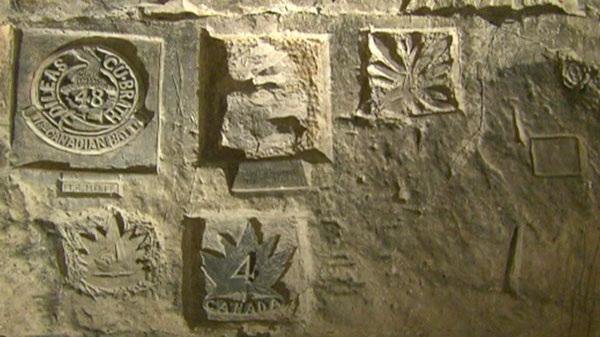
NOTE: Mrs. W. refers to this post about the carvings made by Canadian soldiers of the First World War as they slept, ate and waited in a cave in northern France - S.L.


* * *


Tom Mather's grafitti in the Goodman Subway, Vimy Tunnels


Thomas Laidlaw Mather, born September 9th, 1897, was the youngest child born to John and Mary Ann (Laidlaw) Mather, who owned a farm at Priceville, Ontario, Canada. His father, John, died in 1901 from injuries after being kicked by a horse. Tom’s brother, William, 14 years his senior, ran the farm so Tom could remain in school.

Tom enlisted with the 147th Grey Owen Sound Battalion, Canadian Expeditionary Forces, on November 30th, 1915. The 147th trained in Grey County until the spring of 1916, when they moved to Camp Niagara. The Battalion relocated to the newly opened Camp Borden, in July 1916, to continue their training. They then moved to the Maritimes in the fall and boarded the RMS Olympic, which was the Titanic’s sister ship and was being used to transport troops to Europe. They arrived in England on November 20th, 1916, and proceeded to Shoreham-by-the-Sea, Sussex, for further training.


Between February and June of 1917, some 350 men of the 147th BN were transferred to the 4th CMR. Tom joined them in the field with the bulk of the 147th on March 7th, 1917, and served with 'A' Company during the assault on Vimy Ridge in April 1917.

There, in the underground tunnel system, he wrote his name on the wall of the "Goodman Subway". A clip of Tom’s graffiti was shown on a television special entitled "Vimy Ridge: From Heaven to Hell", which first aired on the History Channel in Canada, the US and Europe in 2007. This subway system has been explored and documented by the Durand Group but unfortunately was closed to the public due to safety considerations in 2008.

October 26th, 1917, was the first day of the "Second Battle of Passchendaele", and Tom served on the right flank which was being held up by heavy machine gun fire from a German pill box. It is interesting to note that during this same battle, one of Tom’s comrades from the 147th, 19-year-old Private Thomas Holmes from Owen Sound, Ontario, became Canada’s youngest recipient of the Victoria Cross for single handedly and repeatedly rushing a German pill box and destroying it by throwing bombs into it.

Most sadly, Private Thomas Laidlaw Mather, aged just 20, lost his life on the opening day of the battle.


Tom’s mother received a letter stating that her son was missing in action, and later received the Memorial Cross and Plaque. The Mather family was troubled that they never fully knew what had happened to Tom, until a chance meeting in the 1960’s with a person who was previously unknown to them, but was a relative of the wife of Tom‘s nephew. This man was Elmer Stevens, who by coincidence had served with Tom in Passchendaele. He informed Tom’s brother, William, that he had seen Tom shortly before a shell exploded in the area where Tom had been positioned, after which Tom never reappeared. The Mather family was extremely grateful for this information.

There is now a headstone for Tom at the Tyne Cot Cemetery, Zonnebeke, near Ypres (Ieper), Belgium. His name is also recorded on the Mather family tombstone in Priceville, Ont., as well as on the Priceville Cenotaph erected in October 1921 in memory of the local men who had lost their lives in WW1.

The Mather family is appreciative of the work of the Durand Group, who researched the Vimy tunnels, and especially to Ian of www.4cmr.com for his work at maintaining the 4th Canadian Mounted Rifles web-site.

Biography credit to the nephew and great-niece of Thomas Mather.


.

Monday, June 6, 2011

D DAY


Busy on the road this year, so it is my pleasure today to link to an earlier post about Ben Leavell, Canadian veteran of the Normandy Campaign. Ben was the father of a good friend of mine - he departed this earth last summer, but not before seeing his story presented on STORMBRINGER - which I am told brought much pleasure to himself, his family and their circle of friends and acquaintances in the city of Collingwood, Ontario.


U.S. forces landing at Omaha Beach


When Americans think of the great Normandy Invasion, visions of the troops landing under terrible fire at Omaha Beach come to mind.

I must admit, for years I believed (falsely) that the Canadian landings at Juno Beach were a cake walk, that opposition was so light that Canadian troops were able to wade ashore with bicycles over their shoulders.


Au contraire - the Canadians faced a frightening Atlantic Wall, like the Americans at Omaha. Juno Beach was defended by elements of the 736th Regiment of the 716th German Infantry Division, composed of 29 companies and armed with 500 machineguns, 50 mortars and 90 various types of guns.

The main immediate opposition came from three, fairly low grade, battalions of the 716th Division, but the presence of offshore rocks meant that the tide would not be high enough for the landings to begin until half an hour later than those elsewhere, and so the Canadians faced an alerted enemy.


The Canadian landing took place on JUNO beach, on either side of the mouth of the River Seulles.


As on the other invasion beaches, the Canadian landings were preceded by heavy air and then naval bombardment, two hours before the beginning of the landing. Frogmen were charged to open several accesses to the beach, 20 minutes before H Hour, in order to facilitate the navigation of the landing crafts.

In the early morning of June 6, 1944, however the preceding days storm in the English Channel was still not over, although definitely less powerful than the day before. There was strong surge to the seas at Juno, and the waves increased progressively during the approach to the beach.

The attack start time of 0735 hrs was delayed by this strong swell and the lack of visibility affected navigation of the landing crafts. Because the high tide covered much of the beach defenses, the hulls of many landing craft were pierced, causing them to sink. Several of the amphibious "Duplex Drive" tanks became submerged by waves passing above the floating system.

Sappers - charged to open and mark out breaches through the forest of beach defenses - could not work efficiently in the heavy surge. As on Omaha Beach, not enough exits were created before the arrival of the tanks and the landing craft of the second wave.


Despite the risk, the ships transporting the amphibious tanks (Landing Craft Tank, LCT) had to approach close to the beach in order to limit the losses. Thus, some tanks crossed a distance of 600 meters, but the waves remained dangerous.

These delays made it possible for the Germans to reorganize and effectively defend the beaches. By the evening of June 6, 1944, the losses of the 3rd Infantry Division were very high: 1,074 soldiers were killed or wounded; it was the heaviest ratio of losses of the three Commonwealth invasion beaches.


Today's Bird HERE


.

Friday, June 3, 2011

UNDERGROUND CARVINGS MEMORIALIZE CANADIAN SOLDIERS

Canadians have found a unique way to honor their veterans of the First World War.

A long-forgotten subterranean memorial to Canadian soldiers who fought in the First World War will soon see the light of day, thanks to the efforts of a London, Ontario based group.

The unusual memorial was made by the soldiers themselves as they slept, ate and waited in a cave in northern France. They were eventually called to fight at nearby Vimy Ridge, in what would become one of the greatest victories in Canadian military history.

The cave, which is accessible through a small hole in a farmer's field, has been sealed off and largely forgotten since the 1917 battle. British experts reopened the cave five years ago, working to preserve carvings made by soldiers along the cave walls.


Part of an ancient chalk quarry, the cave is a labyrinth of corridors and open spaces that were once lined with hundreds of bunk beds. While recovering from wounds, soldiers carved into the wall.


Alec Ambler, a young stone mason, signed his work and went on to survive the war. Many others weren't so lucky.

A soldier names Elroy Lacey drew animals he remembered from his farm in Dunwich, Ontario. He was later killed in the fighting. Another carver, Grant Phelps, was a railway worker from St. Thomas, Ontario. He was hit by shrapnel in the opening moments of the Vimy Ridge battle and succumbed to his wounds hours later.

Eventually the fighting ended and the cave was abandoned. But there is also some graffiti in the cave dating to 1940, as Belgian refugees hid from the fighting in the next world war.

Now a Canadian group called the Canadigm Team has joined them to document and to make exact replicas of hundreds of pieces of graffiti, which they plan to show across the country.

"This is unique," said retired General Rick Hillier, the honorary chair of the Vimy Foundation. "It's part of our legacy, part of our history."

The etchings by long-dead soldiers are slowly deteriorating, so restorers have been working to document subterranean pre-battle, First World War-era hideouts in France. Soldiers' stories are being researched in preparation for the centenary of Canada's victory at Vimy Ridge.

Canadigm's inaugural exhibit, titled The Souterrain Impressions, will open in the fall of 2013 and will tour across Canada for the next four years, leading up to the 100th anniversary of the battle.


- CTV News


Today's Bird HERE


.

Saturday, March 12, 2011

VEGEMITE


In Defense of Vegemite
by Yvonne Crittenden

I smiled when I read President’s Obama’s remarks about how disgusting he finds Vegemite, Australia’s national condiment. ”It’s horrible” he exclaimed at a Virginia school with visiting Aussie PM Julia Gillard. Growing up in Australia, I routinely smeared the strong yeast extract /Bovril-tasting stuff on my toast and crumpets, like my siblings and most of the other kids I knew. Sometimes we alternated it with Marmite, which is the meatier tasting version of the spread, and hails from Great Britain. In fact, I grew so addicted to it that when I moved to Canada more than 50 years ago, I panicked when I could not find Vegemite. Thankfully, I re-discovered Marmite was available here, imported from England (no Vegemite, however) and got so used to the slightly different taste, I can’t eat Vegemite any more. (Marmite is also available, if you hunt for it, in some American supermarkets).

I take supplies of Marmite on all overseas trips (including Antarctica and the Himalayas) and when fellow tourists see me putting it on my toast, they inevitably ask what it is, and when offered a taste, smell it and hastily decline, wondering how anyone can “eat that stuff”.

I knew my husband Peter, a Canadian, and I were destined for one another when comparing childhoods as we were courting. I found he loved Marmite, too! He had gone to school in England at one point and gotten hooked on it there. My two kids grew up on it, and I have made a point of persuading my grandchildren to get addicted to it too, by offering it to them when they were very small (preferably under three and innocent). Four love it, one doesn’t and the sixth is too small yet to try to convert. So long live Vegemite and Marmite — possibly the last remnants of the British Empire to survive!


Yvonne Crittenden reviews books for the Toronto Sun and has been a full-time journalist since she was 16.


.

Friday, December 3, 2010

CANADA's IMMIGRATION PROBLEM


From The Manitoba Herald

by Clive Runnels

The flood of American liberals sneaking across the border into Canada has intensified this week, sparking calls for increased patrols to stop the illegal immigration. The results of the recent election is prompting an exodus among left-leaning citizens who fear they'll soon be required to hunt, pray, and to agree with Bill O'Reilly and Glenn Beck.

Canadian border farmers say it's not uncommon to see dozens of sociology professors, animal-rights activists and Unitarians crossing their fields at night. "I went out to milk the cows the other day, and there was a Hollywood producer huddled in the barn," said Manitoba farmer Red Greenfield, whose acreage borders North Dakota. The producer was cold, exhausted and hungry. He asked me if I could spare a latte and some free-range chicken.

When I said I didn't have any, he left before I even got a chance to show him my screenplay, eh?”

In an effort to stop the illegal aliens, Greenfield erected higher fences, but the liberals scaled them. He then installed loudspeakers that blared Rush Limbaugh across the fields.

"Not real effective," he said. "The liberals still got through and Rush annoyed the cows so much that they wouldn't give any milk.”

Officials are particularly concerned about smugglers who meet liberals near the Canadian border, pack them into Volvo station wagons and drive them across the border where they are simply left to fend for themselves." A lot of these people are not prepared for our rugged conditions," an Ontario border patrolman said. "I found one carload without a single bottle of imported drinking water. They did have a nice little Napa Valley Cabernet, though."

When liberals are caught, they're sent back across the border, often wailing loudly that they fear retribution from conservatives. Rumors have been circulating about plans being made to build re-education camps where liberals will be forced to drink domestic beer and watch NASCAR races.

In recent days, liberals have turned to ingenious ways of crossing the border. Some have been disguised as senior citizens taking a bus trip to buy cheap Canadian prescription drugs. After catching a half-dozen young vegans in powdered wig disguises, Canadian immigration authorities began stopping buses and quizzing the supposed senior citizens about Perry Como and Rosemary Clooney to prove that they were alive in the '50s. "If they can't identify the accordion player on The Lawrence Welk Show, we become very suspicious about their age" an official said.

Canadian citizens have complained that the illegal immigrants are creating an organic-broccoli shortage and are renting all the Michael Moore movies. "I really feel sorry for American liberals, but the Canadian economy just can't support them." an Ottawa resident said. "How many art-history majors does one country need?"


Friday Filly HERE


.

Thursday, November 11, 2010

Armistice Day - Remembrance Day - Veterans Day


On this day in 1918, on the eleventh hour of the eleventh day of the eleventh month . . . the guns fell silent on the War to End All Wars . . .


Veterans Day was originally known as Armistice Day; the original intent of Armistice Day was to honor the Dead.


In the British Commonwealth, November 11th is known as Remembrance Day. Poppies are displayed to honor to the Dead of all wars.


The Field of Remembrance in front of Westminster Cathedral, London.


The poppies represent the blooms across some of the worst battlefields of Flanders in World War I, their brilliant red color is an appropriate symbol for the blood spilt . . .


In Flanders Fields

In Flanders fields the poppies blow
Between the crosses, row on row,
That mark our place; and in the sky
The larks, still bravely singing, fly
Scarce heard amid the guns below.

We are the Dead. Short days ago
We lived, felt dawn, saw sunset glow,
Loved and were loved, and now we lie,
In Flanders fields.

Take up our quarrel with the foe:
To you from failing hands we throw
The torch; be yours to hold it high.
If ye break faith with us who die
We shall not sleep, though poppies grow
In Flanders fields.


This Armistice Day, STORMBRINGER honors Benjamin Floyd Leavell, World War II veteran of the Grey & Simcoe Foresters and First Hussars Tank Corps (CANADA).


Ben Leavell was a hero in Normandy; on 25 July 1944 he was severely wounded by a German machinegun while trying to rescue his crew from the burning hulk of their tank - his story has been told many times in the newspapers of his native Province of Ontario, and also here in STORMBRINGER.


Canadian forces going ashore in Normandy, June 1944


Ben passed away peacefully this past summer, July 27th, 2010, in his 92nd year; sixty-six years almost to the day of when he was wounded in France. He was survived by his wife Florence (nee Burgess) of 62 years, children Alice, Robert, Helen and Susie; grandchildren Melanie, Miranda, Allison, Ainsley, Lincoln; and six great-grandsons.


STORMBRINGER also honors Sgt. Phillip G. Crittenden, RAAF, KIA 20 October 1941; shot down over Charleroi, Belgium while piloting the lead plane in the first British Bomber Command mission of the war that was led by the Royal Australian Air Force.

The crew of Crittenden's plane, Wellington bomber #FU-D,
just before take off. There was only one survivor.


Sergeant Crittenden was twenty years old at the time of his death.


To Veterans everywhere: Thank you for your sacrifice. Thank you for the Freedom we enjoy.

And to the Honored Dead -


We will never forget you.


.

Thursday, January 21, 2010

TENT CAMPING AND POLAR BEARS

.

Polar Bear Attack in the High Arctic

This is from up in the Northwest Territories (Note to non-Commonwealth readers: that's in Canada) This chap is lucky to be alive. The guy survived the bear attack. The bear jumped on him while he was sleeping in his tent and he managed to get it off of him and shoot it.


ONE TOUGH CAMPER!


This is call a see-through foot. Polar bears are the top predator in the North American continent.


KINDA MAKES YA WANT TO STAY AT HOME AND HIDE UNDER THE BED, EH?


NOTE TO SELF: Before going camping in the Great White Frozen NorthLand, get your hands on one of THESE:


Extra credit if you can identify that airplane . . . . . . . . . . . . . S.L.

Saturday, June 6, 2009

D DAY: ALLIED ORDER OF BATTLE


Operation Overlord, the Allied Invasion of Northern France, was a combined effort of many countries. I wish to give tribute to the brave men & women of the British Commonwealth, and Free France - they fought the Germans in France years before the United States entered the war, of course. Future postings will explore these historical events; Dunkirk, Dieppe, Gold, Sword and Juno Beaches.

Supreme Commander--General Dwight D. Eisenhower
Allied Expeditionary Naval Forces--Admiral Sir Bertram Ramsay
21st Army Group--General Sir Bernard L. Montgomery
Allied Expeditionary Air Forces--Air Marshal Sir Trafford Leigh- Mallory
United States Army United Kingdom Land Forces

First Army Second British Army
V Corps 1st British Corps
VII Corps 30th British Corps
1st Infantry Division 3rd British Infantry Division
4th Infantry Division 6th British Airborne Division
29th Infantry Division 50th British Infantry Division
82nd Airborne Division 3rd Canadian Infantry Division
101st Airborne Division

Air Forces

U.S. Army Air Forces Royal Air Forces

Eighth Air Force 2nd Tactical Air Force
Ninth Air Force

Allied Expeditionary Naval Forces

Western Task Force Eastern Task Force
(United States) (British)


NOTE: This Order of Battle does not mention the Free French forces included in the first wave at the British beaches, nor the Free French forces that jumped in with the British Special Air Service Brigade. Of course, French Resistance forces are not ennumerated here either.


See all STORMBRINGER D-Day posts here

Sunday, May 31, 2009