Showing posts with label UN. Show all posts

Saturday, June 11, 2011

U.N. SMALL ARMS TREATY

This treaty intends to ". . . ban the trade, sale and private ownership of all semi-automatic weapons." The right to self-defense - a basic human right - is codified in our Constitution as the right to own firearms. Not simply hunting or sporting pieces, either. The 2d Amendment addresses a specific requirement:


A well regulated militia being necessary to the security of a free State, the right of the People to keep and bear arms shall not be infringed.


This means American citizenry are allowed the right to arm themselves with military-style firearms, which since the mid-twentieth century specifically means semi-automatic rifles and pistol.


Ever since Obama came into office, gun sales are up.


This sentiment is so strong in America, that liberals who abhor guns seek to have themselves portrayed as pro-hunter when running for the Presidency.


What a doofus - this Liberal didn't fool anyone.


More well known for something that rhymes with duck - for awhile, this Liberal fooled everyone.


Efforts by anti-gun liberals are dangerous to American sovereignty, and any politician who supports the United Nations “Small Arms Treaty” should be run out of office, and quite honestly, the country.


Larry Bell from Forbes has written an op-ed piece about the United Nations “Small Arms Treaty”:


U.N. Agreement Should Have All Gun Owners Up In Arms

Jun. 7 2011 - 2:04 pm

It may not come as surprising news to many of you that the United Nations doesn’t approve of our Second Amendment. Not one bit. And they very much hope to do something about it with help from some powerful American friends. Under the guise of a proposed global “Small Arms Treaty” premised to fight “terrorism”, “insurgency” and “international crime syndicates” you can be quite certain that an even more insidious threat is being targeted – our Constitutional right for law-abiding citizens to own and bear arms.


What, exactly, does the intended agreement entail?

While the terms have yet to be made public, if passed by the U.N. and ratified by our Senate, it will almost certainly force the U.S. to:

Enact tougher licensing requirements, creating additional bureaucratic red tape for legal firearms ownership.

Confiscate and destroy all “unauthorized” civilian firearms (exempting those owned by our government of course).

Ban the trade, sale and private ownership of all semi-automatic weapons (any that have magazines even though they still operate in the same one trigger pull – one single “bang” manner as revolvers, a simple fact the ant-gun media never seem to grasp).

Create an international gun registry, clearly setting the stage for full-scale gun confiscation.

In short, overriding our national sovereignty, and in the process, providing license for the federal government to assert preemptive powers over state regulatory powers guaranteed by the Tenth Amendment in addition to our Second Amendment rights.


Have no doubt that this plan is very real, with strong Obama administration support. In January 2010 the U.S. joined 152 other countries in endorsing a U.N. Arms Treaty Resolution that will establish a 2012 conference to draft a blueprint for enactment. Secretary of State Hillary Clinton has pledged to push for Senate ratification.

Former U.N. ambassador John Bolton has cautioned gun owners to take this initiative seriously, stating that the U.N. “is trying to act as though this is really just a treaty about international arms trade between nation states, but there is no doubt that the real agenda here is domestic firearms control.”

Although professing to support the Second Amendment during her presidential election bid, Hillary Clinton is not generally known as a gun rights enthusiast. She has been a long-time activist for federal firearms licensing and registration, and a vigorous opponent of state Right-to-Carry laws. As a New York senator she ranked among the National Rifle Association’s worst “F”-rated gun banners who voted to support the sort of gunpoint disarmament that marked New Orleans’ rogue police actions against law-abiding gun owners in the anarchistic aftermath of Hurricane Katrina.

President Obama’s record on citizen gun rights doesn’t reflect much advocacy either. Consider for example his appointment of anti-gun rights former Seattle Mayor Greg Nickels as an alternate U.S. representative to the U.N., and his choice of Andrew Traver who has worked to terminate civilian ownership of so-called “assault rifles” (another prejudicially meaningless gun term) to head the Bureau of Alcohol, Tobacco, Firearms and Explosives.

Then, in a move unprecedented in American history, the Obama administration quietly banned the re-importation and sale of 850,000 collectable antique U.S.-manufactured M1 Garand and Carbine rifles that were left in South Korea following the Korean War. Developed in the 1930s, the venerable M1 Garand carried the U.S. through World War II, seeing action in every major battle.


As an Illinois state senator, Barack Obama was an aggressive advocate for expanding gun control laws, and even voted against legislation giving gun owners an affirmative defense when they use firearms to defend themselves and their families against home invaders and burglars. He also served on a 10-member board of directors of the radically activist anti-gun Joyce Foundation in Chicago during a period between 1998-2001 when it contributed $18,326,183 in grants to anti-Second Amendment organizations.


If someone breaks into your home when you are there, which would you prefer to have close at hand: 1) a telephone to call 911, or 2) a loaded gun of respectable caliber? That’s a pretty easy question for me to answer. I am a long-time NRA member, concealed firearms license holder and a regular weekly recreational pistol shooter. And while I don’t ordinarily care to target anything that has a mother, will reluctantly make an exception should an urgent provocation arise. I also happen to enjoy the company of friends who hunt, as well as those, like myself, who share an abiding interest in American history and the firearms that influenced it.


There are many like me, and fewer of them would be alive today were it not for exercise of their gun rights. In fact law-abiding citizens in America used guns in self-defense 2.5 million times during 1993 (about 6,850 times per day), and actually shot and killed 2 1/2 times as many criminals as police did (1,527 to 606). Those civilian self-defense shootings resulted in less than 1/5th as many incidents as police where an innocent person was mistakenly identified as a criminal (2% versus 11%).

Just how effectively have gun bans worked to make citizens safer in other countries? Take the number of home break-ins while residents are present as an indication. In Canada and Britain, both with tough gun-control laws, nearly half of all burglaries occur when residents are present. But in the U.S. where many households are armed, only about 13% happen when someone is home.

Recognizing clear statistical benefit evidence, 41 states now allow competent, law-abiding adults to carry permitted or permit-exempt concealed handguns. As a result, crime rates in those states have typically fallen at least 10% in the year following enactment.


So the majority in our Senate is smart enough to realize that the U.N.’s gun-grab agenda is unconstitutional, politically suicidal for those who support it, and down-right idiotic—right? Let’s hope so, but not entirely count on it. While a few loyal Obama Democrats are truly “pro-gun”, many are loathe to vote against treaties that carry the president’s international prestige, causing him embarrassment.

Also, don’t forget that Senate confirmation of anti-gun Obama nominee Supreme Court Justice Sonia Sotomayor. Many within the few who voted against her did so only because of massive grassroots pressure from constituents who take their Constitutional protections very seriously.

Now, more than ever, it’s imperative to stick by our guns in demanding that all Constitutional rights be preserved. If not, we will surely lose both.


Today's Bird HERE


.

Monday, April 18, 2011

WAR IN THE LAND OF CHOCOLATE - PART 2

My story continues . . . Part 1 is HERE - S.L.


Africa is tribal. I saw this in the Ivory Coast – le Cote d’Ivoire – when I was there as a military advisor in 1999. I would tell the Ivorian officer where & when I needed his men, or where to go to next; he would turn around and give a command and half the platoon would tighten up and look alert like proper soldiers. The other half would look down at the ground and shuffle their feet, a lot of attitude and body language. I figured it out real fast; half the platoon was his tribe, Ashanti, the “shuck-and-jive” crowd was of the other tribe; Twee, or Ibo.

On 24 December 1999 what started as a pay mutiny by these same disaffected troops morphed into a coup d’etat, and by 2002 had become a full-blown civil war. At that time my unit was sent in to get 2700+ Americans and other nationalities out of the rebel-held north. What we saw last week - French and UN helicopters firing missiles into the President’s residence in Abidjan - was the culmination of events that kicked off in 1999.


French helicopter attack sortie toward the Presidential Residence in Abidjan, Cote d'Ivoire, April 2011.


The current set of circumstances Cote d’Ivoire relate directly to national elections held in October of last year. Despite losing the election, Laurent Gbagbo refused to step down, never mind the fact that his term in office expired five years ago; he simply refused to leave.

His opponent, Alassane Ouattara, has the support of world leaders, but not of Ivory Coast's military. And so associated himself with the rebel faction, which slowly but surely made its way toward the capital in an almost symbolic combat that claimed less than 500 lives.


Road to War:

In the years leading up to the coup of ’99, the government of President Bédié had drifted toward a xenophobic policy described as “Ivoirité”: the exclusion of immigrant workers from Mali and Burkina Faso, some of whom had been in the country for generations. Ouattara’s father’s side of the family is from Burkina Faso – a fact that confounded Ouattara’s earlier political activities - and so much of the exploited underclass was able to identify with him and the rebel forces that emerged since the civil war of ’02. Another complication in this conflict is the cultural fault line between Muslims in the north, and the Christian majority of the economically prosperous south.

In North America it is difficult to fully appreciate these kind of issues, of course, and all this past month the thing in Libya has eclipsed the situation in West Africa. Oil is important, despite the fact that we could straight up buy the oil from the Libyans if we wanted to – or anyone else - any day of the week, or we can drill for it ourselves. But Cote d’Ivoire has something unique that can’t be found in deserts, arctic regions or at the bottom of the ocean.


Carrying cocoa beans in the port of San Pedro, Ivory Coast; much of the 
nation's economy depends on the exports. (Jane Hahn / New York Times)


Cote d’Ivoire produces almost 50% of the world’s supply of cocoa beans, and the beans have been piling up in the warehouses. There is coffee there as well, and rubber plantations. The rebels say they are fighting for their national identity, but their cause was financed by the power of the beans.


Autumn Return

In September of 2002 my outfit got the word we were going down to the Ivory Coast to evacuate Americans. Normally for this sort of thing the phone rings in the dead of night, you roll over, “Honey, I’m going to be out of town for a couple of weeks.” She says, “Whatever,” and you get a little break from each other’s company.

This time “the balloon went up” at ten in the morning. We immediately went into mission prep, dragged our kit bags, drew our weapons and blew out of there – phone calls to mama-san were out of the question; OPSEC. My wife and kids – ALL the wives and kids – didn’t know where we were for the better part of two weeks.

We flew into Yamousoukro and established ourselves in the airport firehouse – a cement lean-to at the drainage end of the runway. The place was infested with mosquitos. I have lived and worked in the tropics most of my life and I have never seen mosquitos that bad; at one point I looked down at my exposed forearm and it looked like I had black fur. I wiped the insects away and my skin was dripping red with blood.


American Special Forces at Yamassoukro Airport, Cote d'Ivoire, September 2002.


The American refugees assembled at the International Christian Academy in Bouaké. The rebels were having a firefight with the Loyalists; the French Foreign Legion were pulling security in their LAVs (Light Armored Vehicles) and their gun jeeps. The Loyalists would fall back through the Legion’s lines, the Legion would open up on the rebels, the rebels would fall back and the Loyalists would advance; rinse and repeat.

The people we evacuated were mostly missionaries who’d lived there for years. They left everything behind; they were allowed one bag each. We rolled up there in our “GunVees” (modified HumVees bristling with belt-fed weapons), pulled security while the Americans loaded up in school buses, then escorted them back to the airport at Yamoussoukro.


American refugees escorted by American Special Forces, Ivory Coast, September 2002.

(That's me you can see through the windshield of the bus.)


The scene at the airport was equally sad; I saw a Frenchman roll up in his Renault, hop out and say to an African standing nearby, “You want a car?” Then he simply handed over the keys.

At one point I was interviewed by an American intelligence officer. “You’ve been here before? You trained the rebels?”

“That’s right.” I told him about our activities in Akuedo, in 1999.

He asked me what kind of troops they were, their capabilities. I told him that if ever you come under fire from them, the safest place to be is right out in the middle of the road.

“HUH?”

“They can’t hit the broad side of a barn, from the inside.”

He opened up a laptop and showed me photographs of the rebels taken in Bouaké and Korhogo. “Do you recognize any of these guys?”

“Well, they all look the same, but yes I do. That guy’s name is Valere.”

“YOU KNOW HIS NAME?”

“We used to drink beer and play cards together.”


Valere


“What about this guy?”

“That’s Ironman.”

Like all military operations, there was a lot of “hurry-up-and-wait”. I spent an afternoon in an air-conditioned van with an older American gentleman and his wife. She had a strange accent I couldn’t quite put a finger one. To fight boredom I started impersonating the French officers – in French; the wife was going into hysterics, ringing out peals of laughter. Turned out she was Québécois, which explained a lot of things, and he was the “OGA” station chief, which explained even more.

Later, after we returned to Stuttgart, I learned from an Ivoirian I’d stayed in touch with that my buddy Valere was indeed with the rebel forces. It turned out he was killed in action - in Bouaké, the day of the evacuation.


Epilogue:

In February of 2003 I attended a briefing at Special Operations Command, Europe (SOCEUR), in Stuttgart. The officer opened the briefing with, “It’s coup season again down in Africa.” A small team was put on alert to go down to “CDI”, to perform reconnaissance tasks, prepare assembly areas for an evacuation, etcetera. We were told to pack our bags and be ready to launch; the specific guidance was: “Be within one hour of sobriety.”

While waiting for the balloon to go up, my journalist brother emailed me that he would be passing through Frankfurt, headed for an embed slot with the 3d Infantry Division for the then-anticipated invasion of Iraq - could we meet up?

At first I told him I couldn't make it – I was on a one hour string. Then it occurred to me that I was instrumental in my brother’s circumstances - in January I'd made a phone call that got him into the embed program – and if something terrible happened, I would never forgive myself, not seeing him when I had the chance. I had to go, so I called the officer over at SOCEUR. “Can you be back here within one hour?” Sure thing, I told him; normally it’s an hour and a half ride up there, but you can fly over those German autobahns. Never mind the fact there was about an inch of ice all over everything.

My brother and I linked up in the airport - he finagled his way through Customs to get out of the transit lounge. We had a good German breakfast of sausages and beer and joked about how it would be his last beer for a long time. Afterwards we strolled through the side of the airport which is like a giant shopping mall, and I pointed out the escalators to the S-bahn, the trains that go everywhere in Germany. It was still dark outside when my phone went off; all my brother heard was me saying, “Yes sir . . . uh-huh . . . yes sir . . . I’ll be there. I’m enroute.”

I looked up and my brother was grinning from ear to ear; he’d just seen me get THE PHONE CALL. We said our goodbyes and he went his way and I went mine. Two brothers, linking up in Europe, heading in two separate directions to two different wars, on two different continents. Much later my brother described the scene: “It was like being in London, 1942.”

My brother went to the Sandpile and took part in the Great and Glorious War on Terror; I parked my car in front of a gray, non-descript building in a military compound in Stuttgart, went inside and grabbed my kit bag, got on a C-130 and made my way back down to an obscure little war in Africa, in a country most people can’t even find on a map.


SEAN LINNANE SENDS


MMB HERE


.

Sunday, April 17, 2011

WAR IN THE LAND OF CHOCOLATE

Source: CIA World Factbook


Cote d’Ivoire was in the news cycle this past week, a six month West African power struggle culminating with French and UN attack helicopters firing rockets on the Presidential Residence in Abidjan, economic capital of Ivory Coast, a West African nation of 21 million. But the war goes back further than the past six months; I was there for the beginning & early stages of that war, back in the late nineties / early ought-oughts.

It actually began as a military pay mutiny, at Camp Akuedo on the outskirts of Abidjan. I know this because I helped train the soldiers who became known as the rebels.


One of the guys we trained in peacekeeping duties, seen here as a part of the rebel force in Bouaké, Cote d'Ivoire.


We were there as a part of a U.S. State Department program – the African Crisis Response Initiative (ACRI) – teaching peacekeeping skills to company-sized elements from five battalions of the Ivorian military. At the beginning of the program we issued new uniforms, equipment, boots, everything – to the soldiers, many of whom had arrived from their remote bases in uniforms that were rags falling off their bodies, their web gear was held together in places by threads.

At the end of our four-month training program, the soldiers once again appeared in their rags. “What happened?” I asked one of the troops. “Where are your new uniforms, the ones we gave you?”

“The officers, they took them all back, put them in the warehouse.” Good old Third World corruption; we give them foreign aid, the guys in charge rip it off and use it to line their pockets. Your tax dollars at work.


This guy's nom de guerre was Ironman, because of his great physical strength. I still have the heavy steel bracelet he gave me in 1999.


One of the Ivoirians asked me for some money so he could take the train back to his base up north. He was a brother paratrooper, so I shelled out ten bucks – probably a month’s pay for him. This was telling, because later that night, it was the pay thing that kicked off the whole mess.

Third World Armies are paid peanuts. Actually, if they were literally paid in peanuts they’d probably be better off than the puny salaries they make. That’s where things like UN peacekeeping duty come in; UN pay is worth triple what they make, and this is crucial because their retirement scheme is practically non-existent.

Well, President Henri Konan Bedie was on TV that night, giving a big speech about how great things were going. The trouble was, things weren’t going all that great, and hadn’t been in the twelve years since the great Houphouët-Boigny – founding father of Ivory Coast – had died. The troops clustered in the dirt-floored canteen were yelling at the screen, ”Oh YEAH? Well if things are going so good – WHERE’s OUR UN PAY???”

What happened next - after they got enough beer in them - was they went down to the arms room, busted in and secured the firing pins for their rifles (that’s how much their own officers trusted them). Then they rocked on down to the Minister of Defense’s residence – about five miles down the road – and made known their grievances.

The security element at the Minister of Defense’s place returned fire, so the mutineers pulled back and went over to the President’s residence. There was no return fire this time, so the troops took the place down, and the whole country with it.

This was in December of 1999; the wealthiest, most stable nation in West Africa had just experienced its first coup d’etat.


TO BE CONTINUED . . .


. . . . . . . . . . . . . . . S.L.


.

Wednesday, April 13, 2011

MIDDLE EAST CRAZINESS UPDATE

Toyota Wars II - Analysis of the war emerging in Libya; how Gadaffi outflanked the rebels and NATO in a throwback to the high-speed Battles of the Technicals with Chad in the eighties, with graphics.


ARAB LEAGUE TO ASK UN TO IMPOSE NO-FLY ZONE OVER GAZA

Gaza ceasefire brokered by UN official Robert Serry who acts as intermediary between Hamas and Jerusalem.


Arab League Secretary General Amr Moussa plans to present the proposal to the UN Security Council.


KORAN BURNING - IN IRAN


(Washington Times) — Two anonymous young men in Iran, one Iranian and one Afghan, have burned a Koran in protest. This seven-and-a-half minute long video shows the two men, their faces obscured, holding the Muslim holy book and reading prepared statements. They say that Arabs have foisted this book and their homelands and because of it they have gone backwards for 1400 years. They say they dislike the Koran and want it to disappear, adding “Viva freedom!”

Afterwards they stand the Koran on a flat rock, douse it alcohol and light it. One of them hoots and laughs. The book burns fiercely, and after a few moments one of them sprays more alcohol into the flames. The video ends with them warming their hands over the blazing book.


.

Saturday, June 5, 2010

ISRAELs BLOCKADE IS LEGAL

Israeli commandos aboard the
MV Mavi Marmara. On the lower-right the Flag of Turkey is visible.

The Law of Blockade was derived from customary international law and codified in the 1909 Declaration of London, and updated in 1994 in a legally recognized document called the "San Remo Manual on International Law Applicable to Armed Conflicts at Sea".

Some of the key rules: the blockade must be declared and notified to all belligerents and neutral states, access to neutral ports cannot be blocked, and an area can only be blockaded which is under enemy control.

According to Philip Roche, partner in the shipping disputes and risk management team with law firm Norton Rose: "On the basis that Hamas is the ruling entity of Gaza and Israel is in the midst of an armed struggle against that ruling entity, the blockade is legal."


INTERNATIONAL WATERS

Under the U.N. Convention of the Law of the Sea a coastal state has a "territorial sea" of 12 nautical miles from the coast over which it is sovereign. Ships of other states are allowed "innocent passage" through such waters.


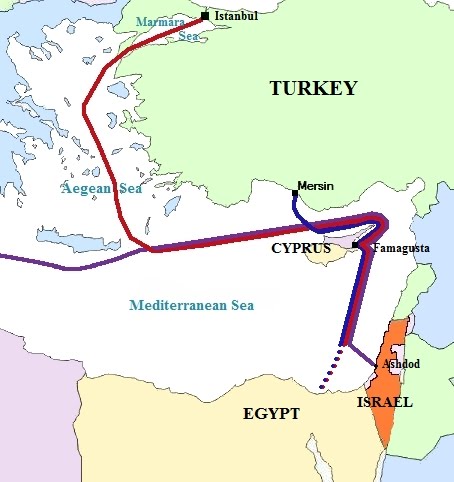
Route of the flotilla


There is a further 12 nautical mile zone called the "contiguous zone" over which a state may take action to protect itself or its laws.

Beyond the 12 nautical miles limit the seas are the "high seas" or international waters.

The Israeli Navy said on Monday that the Gaza bound flotilla was intercepted 120 km (75 miles) west of Israel. The Turkish captain of one of the vessels told an Istanbul news conference after returning home from Israeli detention they were 68 miles outside Israeli territorial waters.

Under the law of a blockade, intercepting a vessel could apply globally so long as a ship is bound for a "belligerent" territory, legal experts say.


MV Mavi Marmara leaving Antalya for Gaza on 22 May 2010 Source: Free Gaza Movement


USE OF FORCE WHEN INTERCEPTING SHIPS

Under International Law a nation can use force when boarding a ship.

"If force is disproportionate it would be a violation of the key tenets of the use of force," said Commander James Kraska, professor of international law at the U.S. Naval War College.

Israeli authorities said marines who boarded the Turkish vessel Mavi Marmara opened fire in self-defense after activists clubbed and stabbed them and snatched some of their weapons.

Legal experts say proportional force does not mean that guns cannot be used by forces when being attacked with knives.

"But there has got to be a relationship between the threat and response," Kraska said.

The use of force may also have other repercussions.

"While the full facts need to emerge from a credible and transparent investigation, from what is known now, it appears that Israel acted within its legal rights," said J. Peter Pham, a strategic adviser to U.S. and European governments.

"However, not every operation that the law permits is necessarily prudent from the strategic point of view."


PIRACY


Opponents have called Israel's raid "piracy"; under international law it was considered a state action.

"Whether what Israel did is right or wrong, it is not an act of piracy. Piracy deals with private conduct particularly with a pecuniary or financial interest," Kraska said.


EFFECTS ON INTERNATIONAL SHIPPING

None so far but the International Chamber of Shipping (ICS), an association which represents 75 percent of the world's merchant fleet, has expressed "deep concern" over the boarding by Israeli forces, arguing that merchant ships have a right to safe passage and freedom of navigation in international waters.

"These fundamental principles of International Law must always be upheld by all of the world's nations," the ICS said.


Don't worry Israel - STORMBRINGER has "got your six"!


.

Thursday, January 28, 2010

The U.N: Corrupt. Incompetent. Unnecessary.


Aid Piling Up at UN's 'Cold Beer' Compound as Red Tape Keeps Aid From Desperate Haitians - While UN Staff Have Wi-Fi and a Bar

- from the U.K. Mail:


It is a tale of two cities. One has ice-cold beers, internet access, thousands of men and billions of dollars’ worth of gleaming machinery, together with piles of food, blankets, generators and other aid relief from around the globe.
This is the heavily fortified US-controlled Port-au-Prince airport and neighbouring United Nations compound.


The other is the devastated city of Port-au-Prince, where the stench of death fills the air and starving people are in utter despair, still in need of the basic necessities of food, water, shelter and medical care...'


MORE


STORMBRINGER has a new friend . . . Crusader Rabbit - from whom I got the above story . . . I will position Rabbit's 'license plate' in the rack to the right, as soon as I figure out how without bothering Theo . . .